30 September 2025 newsworld_wo Uncategorised 0

It was a cold, gray morning in early March when I first saw them. I was rushing to catch the 7:15 bus into the city, clutching my coffee like it was a lifeline, when something made me pause.
There, on the old iron bench outside the post office, sat an elderly man with silver hair curling under a worn knit cap. His coat was threadbare, his pants too short, and his shoes were scuffed to the sole. But he wasn’t alone.
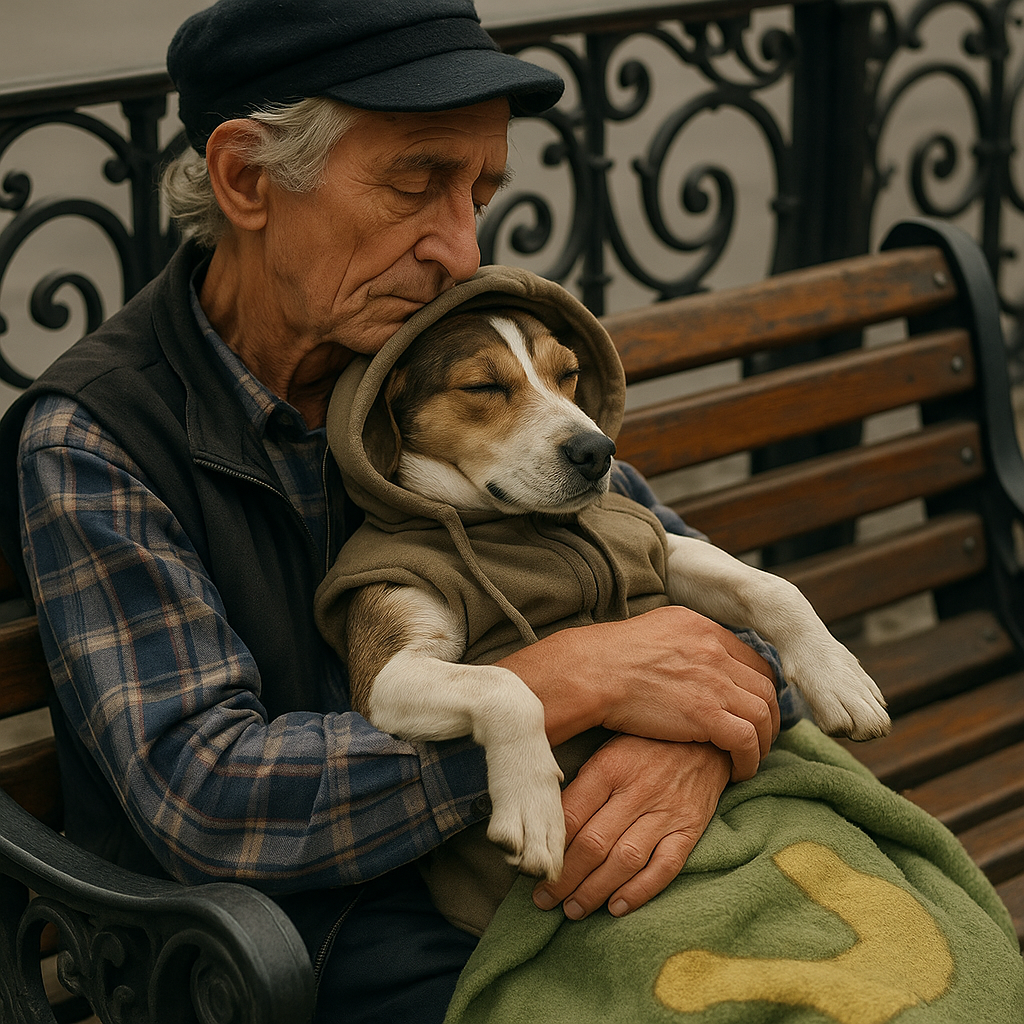
Cradled in his lap, wrapped in a green cartoon blanket and tucked into the crook of his arm like a child, was a dog—a medium-sized mutt with soulful brown eyes and a gray hoodie pulled over its ears. The dog’s head rested on the man’s shoulder. They sat so still, so completely at peace, it felt like I was intruding just by looking.
I almost missed my bus.
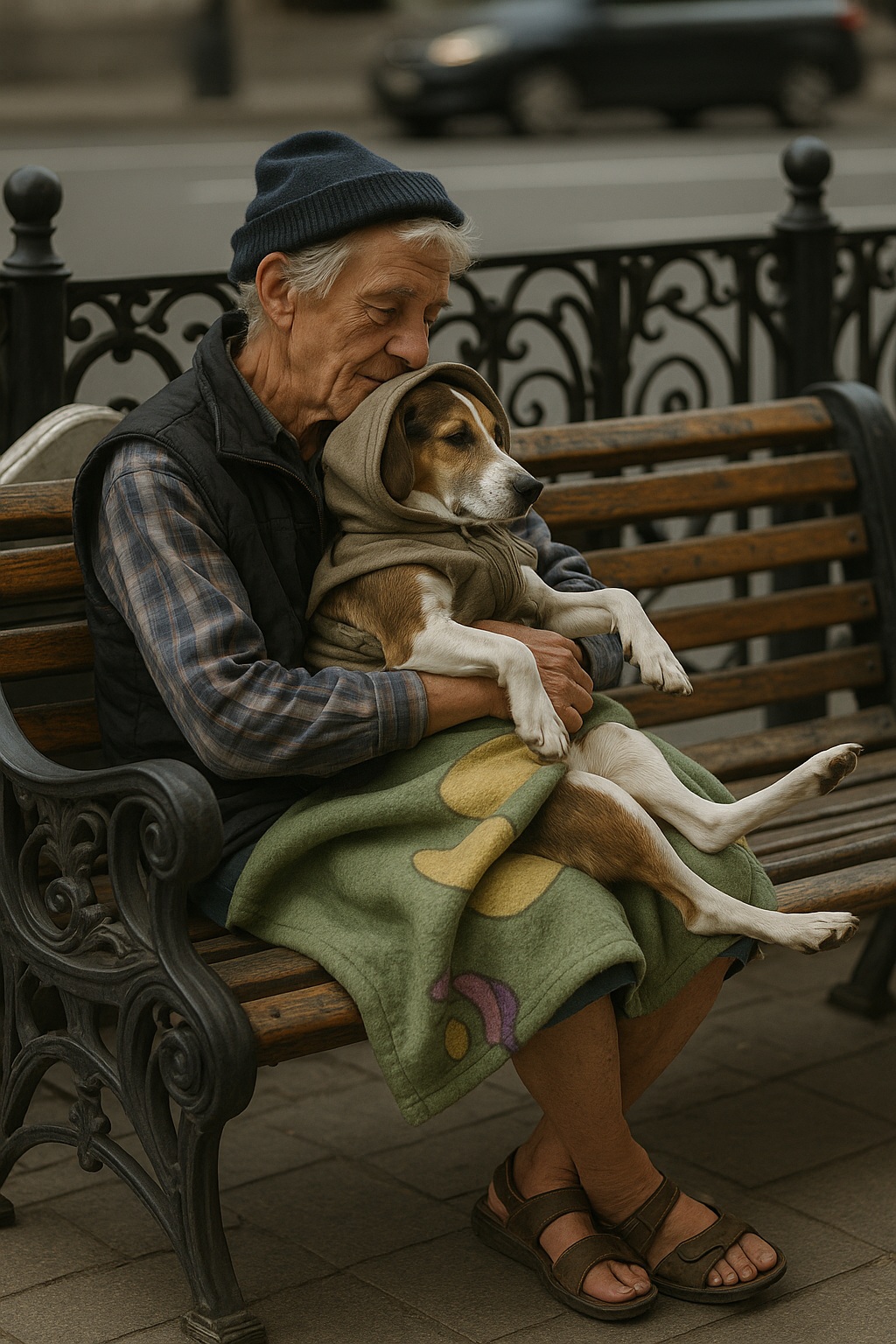
The next morning, they were there again. Same bench, same blanket, same embrace. The man, weathered but calm. The dog, wrapped up like a baby. It became a routine. Each morning as I hurried past, there they were, sharing the quietest kind of love I’d ever witnessed.
By the end of the week, curiosity got the better of me. I left fifteen minutes earlier and crossed the street with a coffee and a breakfast sandwich.
“Morning,” I said, trying to sound casual.
The man looked up, startled. His eyes were pale blue and kind, though heavy with age.
“Morning,” he replied, his voice gravelly but warm.
“I see you here every day,” I said, offering the coffee. “I thought maybe you’d like this.”
He hesitated, then smiled. “That’s mighty kind of you.”
The dog perked up too. I tore off a piece of the sandwich and offered it to him. The man gently took it first, sniffed it, then handed it to the dog.
“This here’s Buddy,” he said, stroking the dog’s back. “Best friend I’ve ever had.”
I sat down on the edge of the bench. “What’s your name?”
“Arthur,” he said. “Arthur Bennett. Been sitting on this bench a while now.”
Arthur’s story came out slowly, over the course of many mornings. He was 72, once a construction worker, then a part-time handyman. His wife, Margaret, had passed away six years ago from cancer. They never had kids. After her death, the bills piled up, the apartment slipped through his fingers, and Arthur eventually ended up on the streets.
He found Buddy about a year ago. Someone had dumped the dog behind a grocery store in a cardboard box, cold and shaking. Arthur took one look at him and knew they belonged together.
“Didn’t think I had anything left to give,” he told me one morning, “but then I saw him and thought… maybe I still got a bit of heart left.”
They became inseparable. Wherever Arthur went, Buddy followed. If Arthur found a warm meal at a shelter, Buddy got the first bite. If it rained, Buddy wore Arthur’s only dry shirt. At night, they curled up together under that cartoon blanket—Arthur’s last possession from the life he’d lost.
I began bringing food more regularly. A fresh sweater. Dog treats. A thick sleeping bag. Arthur never asked for anything, never begged, never complained. He was more concerned with keeping Buddy warm than with his own chattering teeth.
One morning in late April, they weren’t there. Nor the next day. By the third day, I was worried.
I asked the woman who ran the flower shop next door. She said an ambulance had come the day before.
“They took the old man,” she said. “He looked real weak. The dog tried to follow, but the paramedics made him stay behind.”
My heart sank.
That evening, I called every nearby hospital. After five tries, I found him—Arthur had collapsed from dehydration and pneumonia. He was recovering at St. Vincent’s.
I went to visit the next day.
He looked so small in the hospital bed, but when he saw me, his eyes lit up.
“Buddy,” he whispered. “Where’s Buddy?”
I explained that the flower shop owner had been feeding him, and I’d been checking in too. Arthur relaxed.
“I was afraid he’d think I abandoned him,” he said, tears in his eyes. “I never wanted him to be alone.”
He spent two weeks in the hospital. Every day, I visited him. We talked about Buddy, about Margaret, about his years building houses and fixing pipes. There was so much life in his stories, even though life had taken so much from him.
As soon as he was strong enough, the doctor told him he couldn’t go back to the street.
I made some calls. Posted online. Explained everything.
And miracles still happen.
A woman named Hannah responded. She ran a small animal rescue just outside the city and had extra space in a guest cottage behind her farmhouse. “It’s nothing fancy,” she said, “but it’s clean, warm, and there’s a yard.”
She met Arthur at the hospital before he was discharged. Brought Buddy, too. The reunion brought the entire ward to tears. Buddy leapt onto the bed, whimpering and licking Arthur’s face. Arthur held him close and cried like a child.
They moved into the cottage a week later.
I kept visiting—at first once a week, then every two. Arthur gained weight. His color returned. He started fixing things around the farm—mending fences, repairing gates, even planting flowers in old boots for decoration.
Buddy thrived too. He had acres to run, rabbits to chase, and always found his way back to Arthur’s side by dusk.
One afternoon, as we sat on the porch drinking lemonade, Arthur said something I’ll never forget.
“You know, I used to think I had nothing left. No home, no family. Just that bench. But the truth is… I had love. And sometimes love is the strongest thing a man can carry.”
He paused and looked down at Buddy, who was napping at his feet.
“That dog saved me,” he added. “I was living, sure, but I wasn’t alive until he came along.”
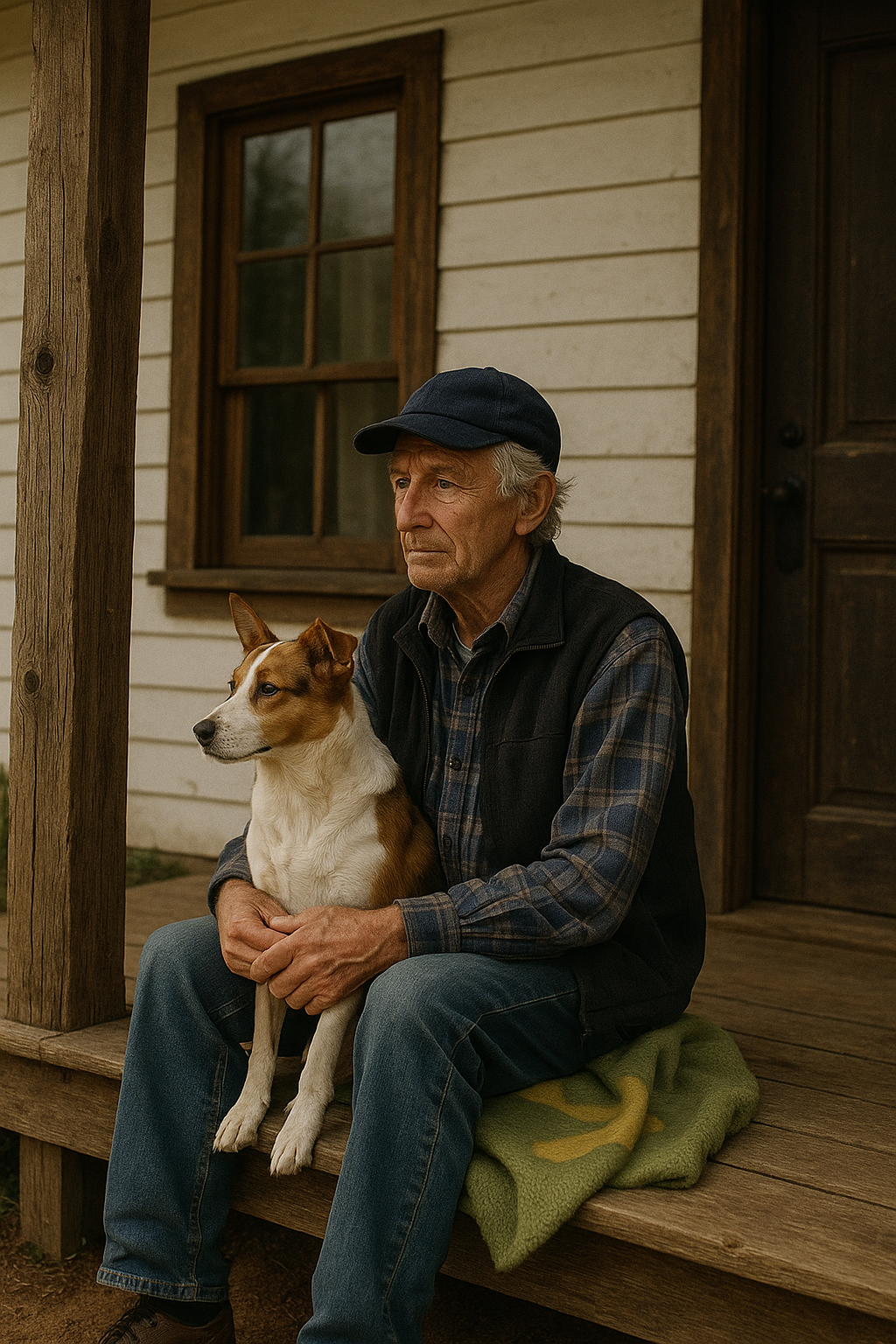
Arthur lived for another three years on that farm. Quiet, happy years filled with walks, laughter, and the peaceful rhythm of country life. When he passed away, Buddy was there beside him, his head on Arthur’s chest, just like on that bench long ago.
Hannah buried Arthur beneath an oak tree in the field behind the farmhouse. Buddy lay beside the grave for days, refusing to eat, until eventually he began to follow Hannah back to the cottage, slow and solemn.
He’s still there now—older, grayer, but still with a spark in his eyes whenever someone sits with him on the porch.
And me? I never forgot them. Every time I see someone rush past a homeless person, I think of Arthur. Of how much love a man can carry with just a blanket, a bench, and a dog.
I think of the thousands of people who probably passed him by, never knowing the strength of the bond he held in his arms. And how a little kindness—a sandwich, a visit, a call—can change the ending of someone’s story.
Arthur had nothing. But he had everything.
And it was the strongest love I’ve ever seen.
If this story touched your heart, share it with someone who believes in second chances, loyal dogs, and the quiet power of love.
This piece is inspired by stories from the everyday lives of our readers and written by a professional writer. Any resemblance to actual names or locations is purely coincidental. All images are for illustration purposes only.

Leave a Reply