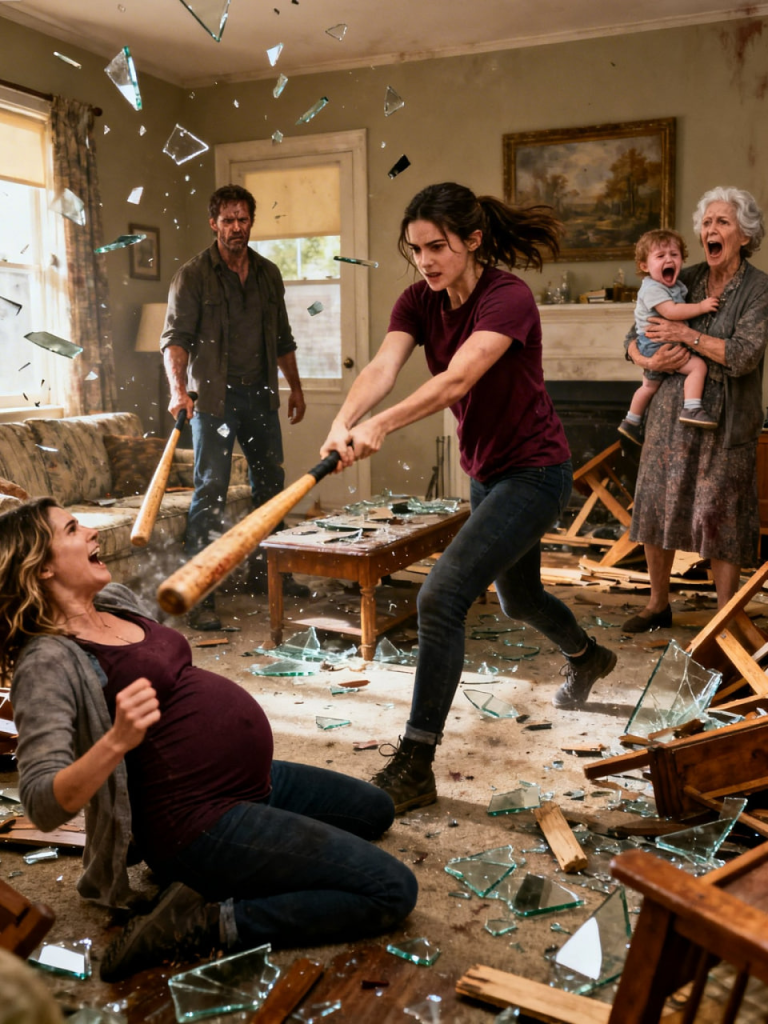
Right before she was about to kick me in the belly, something inside me went ice-cold and oddly clear—like my mind snapped a picture of the moment and filed it away under Survival, Now.
Her sneaker hovered inches from my stomach. The porch light caught the white rubber sole, the dirty lace, the twitch in her ankle like she was deciding whether she’d regret it later.
I remember thinking, So this is who you are when money gets involved.
I didn’t scream. I didn’t plead.
I just grabbed the porch railing with both hands and shifted my weight the way the nurse at the prenatal class told us to if we ever slipped—steady, controlled, protective. Instinct, not grace.
The girl’s name was Trina. She’d shown up twice before with the same dead-eyed men and the same paper-clipped folder. The first time, she pretended to be polite. The second time, she stopped pretending. This third time, she brought bats.
And a van with no plates.
And my sister’s debt, like a curse that had learned how to drive.
“Move,” Trina said, her voice flat as a countertop. She was maybe twenty-two, hair in a tight ponytail that made her face look sharper. A little bruise bloomed purple at the edge of her jaw. Either someone had hit her, or she’d headbutted the wrong kind of person. Either way, it told me she didn’t live in a world where apologies mattered.
Behind her, two men stood in my yard as if they owned the grass. One rolled a wooden bat from palm to palm like he was warming up for a game. The other didn’t bother with props—he just watched, hands tucked into a hoodie, a thin smile like he already knew how the story ended.
I was seven months pregnant. My ankles were swollen. My hands were shaking so hard I could feel the tremor in my teeth.
But my mind was clear.
Because of one simple fact: they were not here for my sister anymore.
They were here for my house.
And if I let them, they’d take everything that lived inside it—my husband’s laugh, my framed photos, my baby’s crib still in its box upstairs.
They’d take my future, one room at a time, and call it collection.
“Claire,” my husband Mateo whispered behind me. He had his phone in his hand, thumb hovering. “I’m calling—”
“Don’t,” Trina snapped, eyes flicking to the phone. “You call and somebody gets hurt.”
Her sneaker dipped, and for half a second the sole touched my belly—light, like a test tap on a watermelon. Then her knee drew back for the real thing.
That was the moment my brain turned into ice.
I didn’t think. I moved.
I slammed my shoulder into the screen door, threw it outward with enough force that it cracked against the porch post, and the metal frame clipped Trina’s shin. She yelped—more surprised than hurt—and her leg buckled. Her kick went wide, slicing air.
Mateo lunged, grabbed my elbow, and pulled me backward into the house.
The bat guy stepped forward, but I was already shoving the door shut.
The latch caught.
For one breath, there was quiet.
Then the bat hit the door.
A hollow THUNK that made the whole frame shudder.
Mateo locked the deadbolt with shaking hands.
Another hit.
Another.
“Claire!” my sister’s voice shrieked from somewhere in the dark yard. “Open the door! It’s not like that! It’s not—”
My sister Jenna. Of course she was there. Of course.
Her voice sounded like it always did when she wanted something: panicked and sweet at the same time, a syrupy emergency.
I pressed my palm to my belly. The baby kicked—tiny, frantic, like she felt the fear in my blood.
“Go upstairs,” I told Mateo. My voice came out low and steady, which surprised me. “Get the bedroom lock. Get the old phone. Don’t argue.”
Mateo’s eyes were wide. “What are you going to do?”
I looked at the front window. Through the thin curtain, I saw movement—shadows sliding across my yard like spilled ink. A bat lifted. A shoulder angled. A face leaned close to the glass, trying to see inside.
“I’m going to make sure we don’t die tonight,” I said.
And then I did something I never would’ve done before pregnancy—before survival had its own filing cabinet in my brain.
I turned on every light in the house.
Kitchen. Living room. Hallway. Lamp by the couch. Porch light again, flooding them in yellow glare.
Let them see me.
Let the neighbors see them.
Let anyone driving by see this wasn’t a quiet, private intimidation. This was a crime scene still waiting to happen.
I grabbed my keys off the hook and my old aluminum baseball bat from the closet—Mateo’s high school relic, lightweight and dented, a sentimental joke until it wasn’t.
My hand shook around it.
I faced the door anyway.
“Claire!” Jenna screamed again. “Please!”
Her voice hit something tender inside me. A memory.
Jenna at twelve, crying in the bathtub after Dad threw a plate at the wall and it shattered like fireworks. Jenna at sixteen, hugging me so tight I couldn’t breathe when Mom left for three days without telling anyone. Jenna at twenty-one, promising me she’d changed, she was clean now, she’d never bring trouble to my doorstep again.
And then Jenna at twenty-eight, standing in my yard with men holding bats.
Family love. Turned into a weapon.
I didn’t open the door.
Instead, I pulled my phone from my pocket, took a picture through the glass pane beside the frame—Trina’s face, the bat guy, the other man’s smile.
Flash on.
Trina squinted, anger flickering.
“Delete that,” she shouted.
I held the phone higher, angled it toward my neighbor’s house across the street. Old Mr. Benson always watched late-night TV with the volume too loud. He’d told me once he didn’t sleep much anymore. Vietnam, he said. Nighttime never felt safe.
“Well,” I murmured, like I was talking to myself, “now I know who to call.”
Mateo came back down the stairs fast, breathless. He held the cordless landline handset in one hand—the ancient one that still worked when the power was out—and a small metal lock in the other.
“We can’t call,” he whispered. “She said—”
“I know what she said,” I replied. “But she doesn’t decide what happens in my house.”
Then I dialed 911.
Trina’s bat hit the door again, harder, right as the operator answered.
“911, what’s your emergency?”
I kept my voice calm. “There are multiple people outside my home with baseball bats attempting to break in. I’m seven months pregnant. My husband is here. Please send police.”
Outside, Jenna screamed, “No! Claire, don’t—”
Trina yelled something I couldn’t make out.
The operator asked for my address. I gave it.
I looked through the curtain again, and that’s when I saw the van.
Parked crooked at the curb. Dark windows. No plates.
A sliding side door cracked open, like a mouth.
I don’t know if they meant to kidnap me that night or just scare me into signing something. But in that moment, seeing the van, my survival file folder slammed shut on one conclusion:
They weren’t leaving without a piece of me.
The sirens arrived fast—our town wasn’t big, and there wasn’t much to do on a Tuesday night except respond to trouble.
Trina and the men scattered like roaches under sudden light. Jenna hesitated, eyes wide, and for one second her face looked like the little sister I used to braid hair for.
Then she ran too.
The police took statements. Walked the yard. Looked at the splintered wood around my doorframe.
One officer—young, tired eyes—asked, “Do you know who they were?”
I held up my phone with the pictures. “Yes. And I can tell you why.”
Jenna’s debt.
That’s where the nightmare started. But not the way people think.
People love the simple version: sister borrows money from bad men, bad men come for collateral, family suffers. It fits in a headline. It fits in a warning story you tell at Thanksgiving.
The truth was uglier and more intimate.
Because Jenna didn’t just owe them money.
She owed them access.
And she used me as payment.
Three months earlier, Jenna showed up at my door with a grocery bag full of baby clothes and a smile that didn’t reach her eyes.
“Peace offering,” she said, holding up a tiny yellow onesie. “For my niece.”
I should’ve known then. Jenna never brought gifts unless she wanted forgiveness, and she never wanted forgiveness unless she’d already done something unforgivable.
I was making iced tea when she sat at my kitchen table and started telling me about her “new job.” Something administrative, she said. Something with commissions. Something that sounded like a lie assembled out of buzzwords.
Mateo stood at the sink, washing dishes, watching her reflection in the window like he didn’t trust her to stay solid.
Jenna tapped her nails on my table. “So… how’s the house? Still dealing with that roof leak?”
“It’s fine,” I said. “We patched it.”
“That’s good,” she said too quickly. “Because this place… it’s a real asset.”
Mateo’s hands froze in the sudsy water.
I felt my baby shift inside me, like she didn’t like the word asset.
“Why are you talking like that?” I asked.
Jenna laughed, bright and wrong. “What? I’m complimenting you. You and Mateo are doing great. You always were the responsible one.”
Mateo dried his hands slowly. “What do you need, Jenna?”
Jenna’s smile trembled. “Nothing. I just… I’ve been thinking about family. About what we owe each other.”
That word again. Owe.
I took a sip of tea, and it tasted like pennies.
“Jenna,” I said carefully, “are you in trouble?”
She stared at my belly, not my eyes. “If I were,” she whispered, “you’d help me, right?”
I should’ve said no.
I should’ve said I will help you get clean, get safe, find a shelter, call a lawyer. I will not help you hide from the consequences of your choices.
Instead, because she was my sister and because love makes you stupid, I said, “Tell me what’s going on.”
Jenna didn’t tell me everything. She never did. She told me enough to hook me: she owed money, yes, but she’d “almost fixed it,” and she just needed time, and could she maybe stay here a few nights if things got weird?
Mateo said no immediately.
I said maybe.
And that “maybe” cracked our front door open.
Not that night with the bats.
Earlier.
Quietly.
With Jenna’s voice and her sorry eyes and her habit of turning every boundary into a suggestion.
She stayed two nights. Then four. Then she started bringing her phone into the bathroom to whisper for long stretches. Then she started asking about the deed.
“I’m just curious,” she said one afternoon, flipping through mail on my counter like it was hers. “Mom ever put her name on this place?”
“No,” I said. “She signed it to me after Dad died. You know that.”
Jenna’s face tightened. “Lucky you.”
“It wasn’t luck,” I snapped. “It was responsibility. I took care of them. I stayed. You left.”
Jenna’s eyes went glassy, and I hated myself for saying it because it was true and because truth, with Jenna, always turned into a weapon.
“I didn’t leave,” she whispered. “I escaped.”
“And then you came back with chaos,” Mateo said, voice hard.
Jenna flinched like he slapped her. “I’m trying.”
I wanted to believe her. I wanted my baby to have an aunt who didn’t break hearts for fun.
So when Jenna left after a week, hugging me too long and whispering, “Thank you, Claire. I won’t forget this,” I let myself exhale.
I thought the danger had passed.
Then Trina came with the folder.
After the police left that night, Mateo and I sat on the couch in the bright living room, lights still blazing like a barrier.
My hands wouldn’t stop shaking.
Mateo held my fingers and pressed his mouth to my knuckles. “We should go to a hotel,” he said. “Just for tonight.”
“And leave the house empty?” I whispered. “So they can break in without witnesses?”
Mateo’s jaw tightened. “Then what do we do?”
I stared at the dark window. “We stop thinking of this like a family problem,” I said. “We start treating it like what it is.”
“A crime.”
“Yes,” I said. “And criminals make mistakes.”
The next morning, I drove to Jenna’s apartment.
Her building smelled like stale smoke and old cooking oil. The hallway carpet had stains shaped like accidents nobody cleaned up.
I knocked on her door.
No answer.
I knocked again, harder.
A neighbor cracked her door open. A woman with tired eyes and a toddler on her hip looked me up and down.
“You looking for Jenna?” she asked.
“Yes,” I said. “Is she home?”
The woman snorted. “Haven’t seen her since last night. She left with some guy in a black van.”
My stomach dropped so fast I thought I might throw up.
“A van?” I repeated.
“Yeah,” the woman said. “No plates. Creepy. She was crying. He didn’t care.”
I pressed my hand to my belly, trying to breathe through the sudden tightness.
The woman looked at my stomach and softened. “You okay, honey?”
“I’m fine,” I lied. “Do you know where she went?”
The woman shook her head. “You don’t want to know.”
I did, though. I wanted to know. I wanted to grab my sister by the shoulders and shake her until the truth fell out.
But I couldn’t find her.
And within twenty-four hours, Trina was back.
This time, in daylight.
No bats.
Just papers.
She stood on my porch like a salesperson, holding a folder and smiling like she hadn’t tried to break my door the night before.
“You’re making this harder than it needs to be,” she said.
Mateo stood behind me, phone already recording in his pocket. We’d talked about it all night—what to do, what to say, how to not let fear make us stupid.
“I don’t know you,” I said. “Get off my property.”
Trina’s smile didn’t move. “You know Jenna, though.”
She opened the folder and slid a page forward.
A photocopy of my deed.
My signature—my name—written at the bottom in black ink.
Only it wasn’t my signature.
It was close, but wrong. Like someone had tried to mimic it with a shaky hand.
My vision tunneled. “That’s forged.”
Trina shrugged. “You can argue that in court. Meanwhile, we’re here to secure the asset.”
“The asset,” Mateo repeated, voice low. “Our home. Where my wife lives. Where our child will live.”
Trina tilted her head. “Your wife’s sister used it as collateral. That’s family business.”
“It’s fraud,” I said. “And extortion.”
Trina leaned closer, lowering her voice. “You can call it whatever you want. But you have two options. Sign the papers, let us list the property, and you walk away without… unpleasantness.”
Mateo stepped forward. “Or?”
Trina’s eyes flicked to my belly. “Or you keep being difficult.”
The baby kicked hard, as if she understood the threat.
Mateo’s hand found mine, squeezing.
I stared at Trina’s face and realized something chilling: she wasn’t improvising. This wasn’t a desperate last move.
This was a script.
And Jenna was part of it.
“Where is my sister?” I asked.
Trina smiled wider. “Safe. For now.”
Then she turned and walked away like she’d just dropped off a pizza menu.
That night, Mateo installed cameras.
We changed the locks.
We told the neighbors to call if they saw the van.
We filed a police report about the forged deed, the threats, the attempted break-in.
And still—still—when I tried to sleep, I felt the phantom of that sneaker hovering over my belly.
Survival, Now.
My mind kept snapping pictures.
Faces. Voices. License-plate-shaped blank spaces.
And Jenna’s scream in the yard: It’s not like that!
Except it was.
It was exactly like that.
Two months later, I gave birth to my daughter, Rosie, in a hospital room that smelled like antiseptic and warm blankets.
Mateo cried when he held her. Real tears. Quiet ones that made his shoulders shake.
I didn’t cry right away.
I just stared at her tiny face and thought, They will not touch you.
I repeated it like a prayer.
The first week home, I barely left the couch. Rosie slept in a bassinet beside me, and every time a car drove past, my heart jumped.
Mateo took paternity leave and barely blinked. He checked locks twice. Three times. He slept in short bursts like a soldier.
We didn’t hear from Jenna.
We didn’t hear from Trina.
For a few days, I let myself believe maybe the police report scared them off.
Then, on a rainy Thursday night, the power flickered.
And the cameras went dark.
Mateo swore under his breath and reached for his phone flashlight. “Generator should kick on,” he muttered.
It didn’t.
The house filled with a thick, wet darkness.
Rosie started crying, sharp and sudden.
I lifted her, whispering, “Shh, shh, Mama’s here.”
Mateo moved toward the back door to check the breaker box.
And that’s when the glass shattered.
Not the front this time.
The kitchen window.
A crash like a gunshot.
Rosie screamed.
Mateo spun, eyes wild.
I didn’t think. I moved.
Survival, Now.
I grabbed Rosie and ran for the hallway, toward the bedroom, toward the lock Mateo had installed.
Behind me, heavy footsteps thudded on the kitchen tile.
A flashlight beam sliced through the dark, sweeping walls.
A man’s voice hissed, “Grab her.”
I slammed the bedroom door and threw the deadbolt.
Mateo hit the door from the inside, bracing it with his shoulder.
“Call!” he barked. “Call 911!”
My hands fumbled, shaking so hard I almost dropped Rosie. I pressed the phone to my ear.
No signal.
The power outage had knocked out the router and the booster. We lived on the edge of town where service was already bad.
A fist slammed against the door.
Wood creaked.
Rosie screamed again, her face red, her tiny body trembling.
I pressed my lips to her forehead. “It’s okay,” I whispered, lying like it could protect her. “It’s okay.”
The door bowed inward.
Mateo grunted, pushing back.
Another slam.
And then—a voice I knew.
Jenna.
“Claire,” she called, her tone high and frantic. “Please open the door! They’re going to—”
“Shut up,” a man’s voice snapped at her.
The doorknob rattled.
Mateo’s face was pale in the dim light. “They cut the power,” he whispered. “They planned this.”
Another slam. The wood cracked near the latch.
I looked around the bedroom desperately for options.
Window. Dresser. Closet.
Then my eyes landed on the baby monitor.
The little handheld screen glowed faintly—battery-powered. We’d charged it earlier.
On it, the nursery camera showed a corner of Rosie’s room: the crib, the rocking chair, the soft nightlight still on because it had its own battery.
And in the doorway—
A silhouette.
Someone already inside.
My blood turned to ice.
“They’re in the house,” I whispered. “They’re in the nursery.”
Mateo followed my gaze, saw the screen, and something raw broke across his face.
“No,” he breathed.
The bedroom door cracked again, splintering.
And then, from the hallway, a soft voice said, almost kindly:
“Open up, Claire. Don’t make us take her the hard way.”
Rosie’s cry turned into a wheeze, like even her tiny lungs understood danger.
I did the only thing my survival brain could find.
I opened the closet, shoved Mateo’s duffel bag aside, and pressed the monitor into his hand.
“Go out the window,” I whispered. “Run to Benson’s. Get help.”
Mateo stared at me like I’d lost my mind. “I’m not leaving you.”
“You’re not leaving me,” I snapped. “You’re saving her. You’re saving us. Go!”
The doorframe groaned.
Mateo’s eyes filled with tears. He kissed Rosie’s head once—quick, fierce—then kissed my forehead.
“I love you,” he whispered.
“Go,” I said again.
He climbed out the bedroom window, dropping into the wet bushes below.
I turned back to the door just as it burst inward.
Wood splintered. Metal shrieked.
A man with a bat stepped into the room, flashlight beam hitting my face.
Trina stood behind him, calm as ever, holding a clipboard like this was paperwork.
And Jenna—Jenna stood behind Trina, drenched from rain, eyes wide and glittering with panic.
She looked at Rosie in my arms and made a sound that might’ve been a sob.
“Claire,” she whispered, “I didn’t think they’d—”
“Shut up,” Trina said without looking at her. Then she looked at me. “Hand her over.”
My grip tightened around Rosie.
“No,” I said. My voice sounded strange—flat, like it belonged to someone else. “You’re not taking my baby.”
Trina sighed like I was exhausting. “It’s collateral.”
Rosie’s tiny fingers curled around my shirt.
Jenna’s eyes flicked away from mine.
That was the moment I understood the whole thing, clear as daylight:
Jenna hadn’t just used my house.
She’d used my child.
Because debt collectors don’t just want money.
They want leverage.
And nothing breaks a person faster than the fear of losing their baby.
“Please,” Jenna whispered, voice cracking. “Just—just do what they say, and they’ll give her back. They promised.”
Trina’s expression didn’t change. “We’re done talking.”
The bat guy stepped closer.
My mind snapped another picture: his boots, muddy; the bat’s grain; the angle of his shoulders.
Survival, Now.
I backed toward the dresser, heart hammering so hard I could taste blood.
“Claire,” Trina said, softer. “Don’t be stupid.”
I looked at Jenna. Really looked.
Her face was wet with rain and tears, but behind it was something else—something like relief, like she wanted this to be over even if it destroyed me.
“Did you forge my signature?” I asked.
Jenna flinched. “I—”
Trina snapped, “Answer her.”
Jenna’s mouth trembled. “They said it was just a formality. They said you’d never know. They said you’d be fine because you’re always fine, you always land on your feet—”
I laughed once, sharp and bitter. “So you decided to see if my baby could land on hers?”
Jenna sobbed. “I didn’t mean—”
The bat guy lunged.
I turned, shielding Rosie instinctively.
And then something slammed into my back—hard, blunt, like a door closing.
Pain exploded across my ribs.
I stumbled.
Rosie screamed.
A hand ripped her from my arms.
For one horrific second, her tiny fingers clung to my shirt, stretching the fabric.
Then she was gone.
Trina stepped back as the man holding Rosie moved toward the hallway.
“Wait—” I gasped, trying to stand, trying to breathe.
Trina crouched, her face close to mine. “You’ll get her back when you sign,” she said. “And when you stop making trouble.”
My vision blurred. I tasted metal.
Jenna stood over me, shaking, whispering, “I’m sorry, I’m sorry, I’m—”
I stared at her through the haze.
And somewhere inside me, the last soft part of sister-love snapped clean in half.
They left me on the bedroom floor with rainwater dripping from the broken window and splinters in the carpet like teeth.
When Mateo burst back in with Mr. Benson and the police five minutes later, Rosie was already gone.
And my house—my safe place—looked like it had been staged.
A lamp knocked over. A smear of blood on the hallway wall—not mine.
A broken picture frame with Jenna’s photo inside, shattered face-up like someone wanted it found.
Family love, turned into a crime scene.
And when the police saw the mess, one officer’s eyes narrowed like he’d already decided who the villain was.
Because in stories like this, the easiest suspect is always the mother with the shaking hands.
They questioned me at the station while my ribs ached and my milk came in like a cruel joke—my body trying to feed a baby that wasn’t there.
An officer asked, “Any history of postpartum issues?”
I stared at him. “My baby was taken.”
He asked, “Did you or your husband have an argument tonight?”
I said, “My baby was taken.”
He asked, “Your sister’s blood was found on your hallway wall. Do you know why?”
My head snapped up. “What?”
He slid a photo across the table. A smear. Dark, fresh.
Not mine. Not Mateo’s.
Jenna’s.
I felt the room tilt.
They were framing us.
Not just stealing Rosie.
Trying to bury us under suspicion so nobody would chase them.
Mateo sat beside me, jaw clenched, hands cuffed “for procedure” until they “cleared things up.”
I wanted to scream until the walls shook.
Instead, my survival brain opened its file folder.
Pictures. The forged deed. The bat marks on the door. The neighbor who saw the black van. The faces I photographed.
And one more thing:
Trina’s calm voice at the bedroom door.
“We’re done talking.”
People like her didn’t do messy unless they were protected.
That meant there was a system behind her. A front. A business.
I lifted my chin and looked the detective in the eye.
“I want to file an official kidnapping report,” I said. “And I want you to look at the deed fraud case you ignored. Because this is connected.”
The detective hesitated—just a flicker.
Good.
That meant he wasn’t completely dead inside.
“What makes you so sure?” he asked.
“Because they told me,” I said, voice steady. “They said my baby is collateral. And my sister is involved.”
Mateo stared at me, shock and pain twisting his face.
I swallowed hard. “I’m done protecting Jenna,” I whispered. “She stopped being my sister when she handed my child to strangers.”
The next forty-eight hours were a blur of fluorescent lights and paperwork and the kind of fear that turns time into thick syrup.
They released Mateo when Mr. Benson confirmed seeing intruders and when my bruises matched the story.
They took my statement again, and this time I gave them everything—names, descriptions, the photos, the van detail, the forged signature.
I watched officers exchange looks when I mentioned “collateral.”
One of them muttered, “This sounds like Ridgeway.”
That was the first real lead.
Ridgeway Recovery Services—local, “legit,” advertised on billboards about “helping you resolve your debts.”
I didn’t wait for the police to connect dots at their own pace.
I went to the hospital for a rib scan, got pain meds I barely felt, then went home and dug through every scrap of paper Jenna had ever left behind.
In the bottom of a kitchen drawer, beneath takeout menus, I found it:
A receipt. Crumpled.
“RIDGEWAY RECOVERY—PAYMENT PLAN—CLIENT: J. WATERS.”
Jenna Waters.
My sister.
And scribbled on the back, in Jenna’s looping handwriting:
“Trina says bring the baby if Claire won’t sign.”
My vision went black at the edges.
Mateo caught my shoulders. “Claire,” he whispered. “Breathe.”
I breathed.
Then I did something I’d never done before in my life.
I got angry in a way that felt clean.
Not messy panic. Not sobbing desperation.
A focused, precise rage.
Survival, Now.
I called Detective Halvorsen—the one who’d hesitated.
“I have proof,” I said. “And I want you to come see it.”
He came.
He read the note.
His face tightened. “This is… significant,” he said carefully, like the word kidnapping ring was too big to say out loud.
“Find my daughter,” I said. “Or I will.”
He looked at my bruises, my swollen eyes, my milk-stained shirt.
“Mrs. Alvarez—”
“Claire,” I snapped. “My name is Claire. And my baby is not a bargaining chip.”
Halvorsen exhaled slowly. “We’re getting a warrant.”
“Good,” I said. “Because I’m getting one thing too.”
He frowned. “What?”
I held up my phone.
A voicemail.
From an unknown number.
Trina’s voice, smooth as glass:
“Claire. You have until tomorrow at noon. Bring the signed papers to the old canning plant by the river. Come alone. Bring the deed. If you involve police… you won’t see her again.”
Mateo let out a broken sound.
Halvorsen swore under his breath.
I stared at the voicemail and felt my survival brain file it away under Evidence.
Then I looked at Halvorsen and said, “You’re going to let me go.”
He stared back. “No.”
“Yes,” I said. “Because they think I’m afraid. And I am. But I’m also their best chance.”
Halvorsen’s jaw flexed. “They’re dangerous.”
“So am I,” I said quietly. “In a different way.”
The next day, I drove to the old canning plant with my heart beating so hard it hurt.
I didn’t go alone.
Halvorsen had unmarked cars hidden downriver. Officers stationed in the woods. A plan.
And I had my own plan too—because I didn’t trust anyone else to care about Rosie the way I did.
I wore a cheap hoodie. No jewelry. My hair pulled back.
In my pocket, a small tracker—one Mateo used for his work tools—taped under the folder where the “signed” papers sat.
I hadn’t signed anything.
Mateo had printed copies, and I’d practiced my signature until my hand stopped shaking.
If they wanted handwriting, I’d give them something that bought time.
The canning plant loomed gray and wet, windows broken like missing teeth. The river behind it moved slow, dark, indifferent.
Trina stood inside the open loading bay, hands in her jacket pockets. The bat guy leaned against a pillar.
And Jenna—Jenna stood beside them, arms wrapped around herself, eyes hollow.
My throat tightened so hard I could barely speak.
“Where is she?” I demanded.
Trina tilted her head. “Papers first.”
I held up the folder. “Show me my baby.”
Trina nodded once.
The bat guy stepped back into the shadows.
A moment later, I heard a soft, thin cry.
My whole body lurched toward the sound.
Then Rosie appeared—held in the crook of the bat guy’s arm like a sack of groceries.
Her face was red, her little fists clenched. But she was alive. She was there.
My knees almost gave out.
“Rosie,” I whispered.
Trina stepped closer. “Folder.”
I held it out with shaking hands.
She took it, flipped it open, scanning fast.
“You learn quick,” she murmured.
I forced my eyes onto Jenna. “How could you?”
Jenna’s lips trembled. “I didn’t think,” she whispered. “I just… I just wanted it to stop.”
“It stopped,” I said, voice ice. “For you.”
Trina snapped the folder shut. “We’re done.”
She nodded at the bat guy.
He turned toward the back door with Rosie.
I moved—too fast to think—stepping into his path.
“No,” I said. “You said you’d give her back.”
Trina’s eyes hardened. “I said you’d see her again.”
The bat guy shifted Rosie higher, and she wailed.
Something inside me snapped, clean and bright.
Survival, Now.
I lunged—not at him, not at Rosie—but at the folder in Trina’s hands.
I ripped it away, and as she grabbed it back, the tracker—taped underneath—peeled loose and stuck to her palm for a split second before falling to the concrete.
Trina didn’t notice.
But I did.
I kicked it lightly, sliding it under a broken pallet.
Then I raised my voice—loud, panicked on purpose.
“You’re kidnapping my baby!” I screamed. “Someone help!”
Trina’s face twisted. “Shut up—”
And that was the moment Detective Halvorsen and the officers surged in like a wave.
“Police! Drop the baby!”
Everything erupted at once—shouting, footsteps, the crack of someone slipping on wet concrete.
The bat guy froze, eyes wide.
Halvorsen moved fast, hands up, voice steady. “Easy! Keep her safe. Put her down.”
Rosie screamed.
My chest felt like it was splitting open.
Trina’s eyes darted, calculating.
Jenna burst into sobs, collapsing to her knees.
The bat guy hesitated—and in that hesitation, an officer tackled him.
Rosie slipped.
Time slowed.
My whole body launched forward, arms outstretched.
I caught her.
Not gracefully. Not perfectly.
But I caught her.
Her tiny body slammed into my chest, warm and real, and she cried against me like she knew I was home.
I pressed my face into her hair and sobbed for the first time since she’d been taken.
Around me, chaos continued—Trina being cuffed, shouting, spitting threats; officers shouting orders; Halvorsen yelling for medics.
But none of it mattered.
I had my baby.
I had her.
Mateo came running from the perimeter, ignoring orders, tears streaming down his face. He wrapped both of us in his arms, shaking.
“I’m here,” he choked. “I’m here.”
I held Rosie between us like a fragile miracle.
Over Mateo’s shoulder, I saw Jenna being led away too, wrists cuffed, face crumpled.
She looked at me, mouth opening like she wanted to beg.
I didn’t let her.
Because love doesn’t mean letting someone burn your life down and call it an accident.
Weeks later, the house still smelled faintly of rain and broken wood.
We repaired the window. Replaced the doorframe. Upgraded the cameras with battery backups.
I rocked Rosie in the nursery chair while sunlight spilled through new curtains.
Mateo knelt beside me, his hand resting on Rosie’s tiny foot.
Detective Halvorsen had called that morning. Ridgeway Recovery was being investigated for fraud, extortion, kidnapping. Trina had a record. The “business” had deeper ties. There would be court dates, testimonies, headlines.
Jenna—my sister—had taken a plea deal.
They wanted me to visit her before sentencing.
Closure, they called it.
I thought about it for a long time, staring at Rosie’s sleeping face.
Then I went.
Jenna sat behind glass in the visitation room, looking smaller than I remembered. Like the weight of her choices had finally settled on her shoulders.
She picked up the phone with trembling hands.
I did too.
“I’m sorry,” she whispered immediately. “I swear, Claire, I didn’t want them to hurt you. I didn’t want them to take her. I just—”
“You wanted it to stop,” I said softly.
Jenna nodded, tears spilling.
“And you picked me to pay,” I continued. “Because you thought I’d survive it. Because I always do.”
Her mouth opened, but no words came.
I leaned closer to the glass.
“Here’s what you need to understand,” I said, voice steady. “I did survive. But something died anyway.”
Jenna sobbed harder.
I didn’t feel satisfaction. I didn’t feel victory.
I felt a clean, sharp boundary.
The kind you build when you finally learn that love without limits turns into permission.
“I hope you get help,” I said. “I hope you become someone who doesn’t destroy the people who love you.”
Jenna whispered, “Do you hate me?”
I looked at her through the glass and thought about the porch light, the bats, the van, Rosie’s fingers slipping from my shirt.
“I don’t have room in me for hate,” I said. “I have a daughter.”
Then I stood up.
Jenna pressed her palm to the glass like she wanted to stop me.
I didn’t.
Because the person I used to be—the one who would’ve tried to save her no matter the cost—was gone.
And in her place was a mother.
A woman who knew what survival looked like.
It looked like turning on every light.
Taking pictures.
Calling the police even when someone told you not to.
It looked like refusing to let your baby become collateral.
It looked like this house—still mine—filled with soft breathing and the quiet creak of a rocking chair.
Family love didn’t have to be a crime scene.
Not anymore.
Not in my home.
Not with my child.
Rosie stirred in my arms, eyes blinking open, and for a second she looked right at me like she recognized the sound of my heartbeat.
I kissed her forehead.
“I’ve got you,” I whispered. “Always.”
And this time, I believed it.

Leave a Reply