Tuesday mornings used to feel harmless.
That morning, the air was bright and still—the kind of quiet that makes you believe life is behaving. The coffee smelled like it always did. The sunlight came through the blinds in soft stripes across the kitchen floor. My husband, Eric, had already left for work, and I was packing our daughter’s lunch with the lazy confidence of routine.
Lily padded in wearing her favorite yellow pajama set—little lemons printed on the fabric—and rubbed sleep from her eyes. She was six, almost seven, all elbows and growing limbs, with hair that refused to be tamed no matter how many times I tried to braid it neatly.
“Morning, baby,” I said, smiling as she climbed onto the stool.
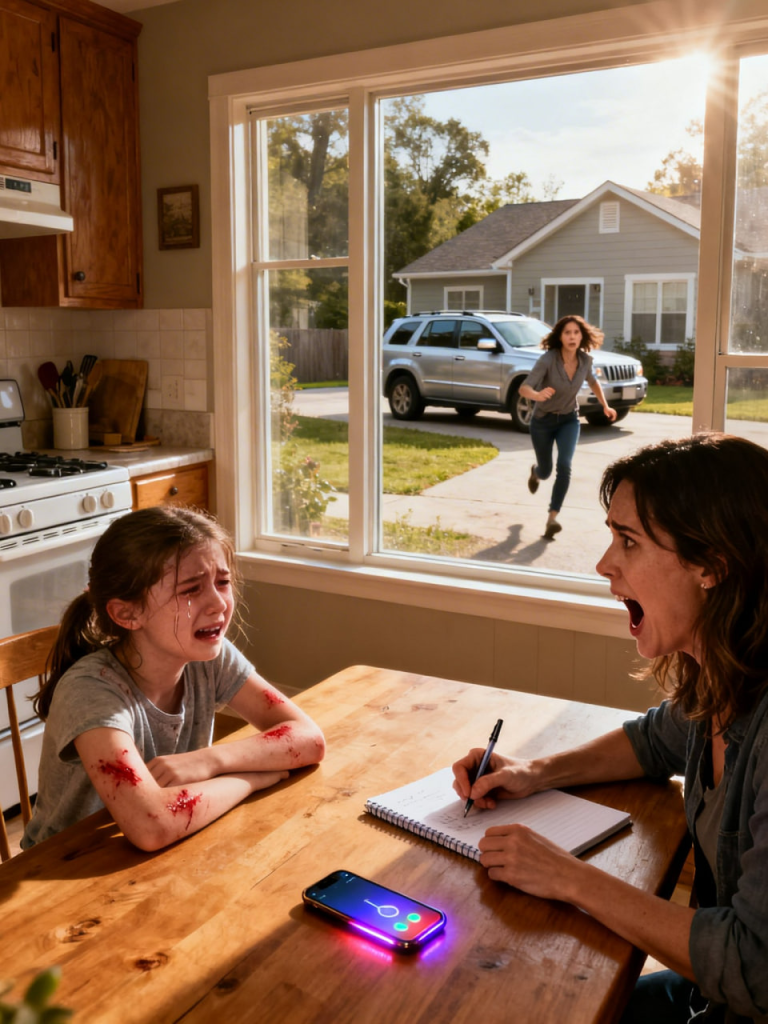
She reached for her cereal bowl and flinched.
It was small—just a twitch of her shoulders, a tightening of her hands—but it hit me like a cold coin dropped down the back of my shirt. Lily didn’t flinch. Lily wasn’t cautious. Lily was the kind of child who ran headfirst into hugs.
“What’s wrong?” I asked, keeping my voice light.
“Nothing,” she said too quickly, staring hard at the table.
The spoon clinked against the bowl as she stirred milk into flakes, like she was trying to make a storm small enough to swallow.
I reached out to smooth her hair and saw it: bruises on her arms, just above the elbows, oval-shaped and dusky purple. The marks looked old enough to have been forming for a day or two, the edges turning that sickly yellow-green.
I froze mid-motion.
For a moment, my mind offered stupid explanations the way it always does when reality feels too sharp.
Maybe she fell.
Maybe she bumped into the coffee table while playing.
Maybe…
But bruises didn’t line up like fingerprints.
They looked like hands.
My hand drifted closer, careful, like the bruises might bite. “Lily,” I said, and my throat tightened. “How did you get these?”
Her eyes darted toward the hallway, toward the living room, toward anywhere but me. “I don’t know.”
Yes, she did.
I crouched so we were eye-level. I kept my face gentle even though a furious animal was waking up in my chest, turning circles and scraping at the walls.
“Sweetheart,” I said, “you can tell me. You’re not in trouble.”
Her lips trembled. She pressed them together as if trying to hold something in. Then she whispered, so softly I almost didn’t hear:
“Grandma said not to tell.”
The kitchen suddenly felt too small. The sunlight through the blinds turned into bars. The coffee smell turned bitter.
Grandma.
My mother-in-law, Diane.
Diane, who kissed Lily’s cheeks too hard at birthdays, leaving lipstick marks like little bruises. Diane, who called herself “the real mama bear” and laughed like it was a joke. Diane, who believed children needed “discipline” the way some people believed in vitamins.
I didn’t speak at first, because if I did, the words that wanted to come out were not safe.
Instead, I took Lily’s hands, one at a time, and turned her palms over. I checked her wrists. Her shoulders. I tried to be subtle, but she shrank in on herself like she was expecting punishment for being inspected.
My heart cracked.
“Did Grandma hurt you?” I asked.
Lily’s eyes flooded. She nodded once, tiny and guilty.
“Why?” I asked, and I heard my own voice sharpen despite my efforts.
She sniffed. “I spilled juice.”
My stomach dropped like an elevator. “Spilled juice?”
She nodded again, tears slipping down her cheeks. “And she got mad. And Aunt Carla said I was doing it on purpose. And Uncle Ron said—said I was getting ‘too big for my britches.’”
Aunt Carla and Uncle Ron.
Carla, Diane’s daughter, who always acted like Lily was a nuisance to be tolerated. Ron, Carla’s husband, who drank too much at family gatherings and liked to talk about “respect” like he owned the patent.
“And… and then Grandma…” Lily’s voice broke. She curled her shoulders inward. “She squeezed. She said I was lying.”
Something inside me shifted—like a lock snapping into place.
I wiped Lily’s tears with my thumbs. “You did the right thing telling me,” I said, forcing my voice to soften. “You’re safe. Do you hear me? You’re safe.”
But even as I said it, my mind flashed back to Sunday.
Sunday was when Eric had taken Lily to his mother’s house for “family dinner.” I hadn’t gone because I’d been recovering from a migraine and—if I was honest—I’d been grateful for an excuse.
Diane’s house was always a battlefield disguised as a dining room.
Eric had come home that night quiet and tense. I’d asked if everything was okay and he’d said, “It’s fine,” the way you say “it’s fine” when you don’t want to start something.
Now the bruises on Lily’s arms were telling me what “fine” really meant.
I stood up so fast the stool scraped the floor. “Lily,” I said, “go put on your clothes, okay? We’re not going to school today.”
Her eyes widened. “Am I in trouble?”
“No,” I said firmly. “Never. You’re not in trouble. Mommy just needs to… take care of something.”
She slid off the stool and ran down the hallway.
I grabbed my phone with hands that shook so badly I almost dropped it. I texted Eric:
Come home. Now. It’s Lily.
Then I called him.
He picked up on the second ring. “Hey—what’s wrong? Is she sick?”
I could hear the background noise of his office—the low hum of fluorescent lights, distant voices. A normal world he was still living in.
“We found bruises,” I said. “On her arms. She said Diane did it. Carla and Ron were involved.”
There was silence, then a sharp inhale. “What?”
“She told me this morning,” I said. “She said she spilled juice and they—Eric, they hurt her.”
His voice turned hoarse. “Are you sure?”
I hated that question, not because it wasn’t reasonable, but because it suggested uncertainty where there was none. I understood why he asked—it was his mother. His family. His brain would be scrambling to protect the story he’d lived inside his whole life.
But my daughter’s bruises didn’t care about his denial.
“I’m looking at the marks,” I said. “Yes. I’m sure.”
“I’m coming home,” he said, and I heard the scrape of his chair, the hurried shuffle.
After we hung up, I stood in the kitchen and breathed through my rage like it was smoke. Lily came back dressed in leggings and a hoodie, her hair still wild.
“Are we going somewhere?” she asked.
“Yes,” I said, forcing calm. “We’re going to the doctor. Just to make sure everything is okay.”
Her mouth pinched. “Grandma said doctors are for when you’re really sick.”
I knelt again and cupped her face. “Doctors are also for keeping you safe,” I said. “And my job is to keep you safe.”
She nodded, but she didn’t look convinced. She looked afraid.
And I realized something awful: fear had already moved into her. Like a squatter. Like something that had been invited by people she’d been told to trust.
That was when I decided Diane’s “discipline” ends today.
At the pediatrician’s office, Lily sat in my lap while the nurse measured her height and weight. She acted brave, but every time someone reached toward her arms, her muscles tightened.
Dr. Patel came in with a warm smile that faded the moment she saw Lily’s bruises.
“What happened here?” she asked gently.
Lily looked at me, eyes wide, waiting for the rules. Waiting to see if telling would cost her.
I squeezed her hand. “You can tell Dr. Patel,” I whispered. “You’re safe.”
Lily swallowed. “Grandma… grabbed me,” she said in a voice barely above air. “And Aunt Carla… said I was lying.”
Dr. Patel didn’t react with shock the way I feared she might. She reacted with focus. With the calm of someone trained to see damage and take it seriously.
She examined Lily’s arms, asked a few questions, documented everything carefully. She spoke to Lily about safe adults, about speaking up. She spoke to me about next steps.
“I’m required to report suspected abuse,” she said quietly, looking me in the eye. “It’s not a choice.”
“Do it,” I said instantly.
My voice didn’t shake. My hands did, but my voice didn’t.
She nodded, as if she’d expected that. “I’ll have my nurse take photographs for the record,” she said. “And I recommend you contact law enforcement as well. At minimum, you’ll want a report filed.”
I felt like I was watching myself from far away—like this was someone else’s life. Someone else’s nightmare.
But Lily leaned against my chest, small and warm, and I knew it was real.
After the photos, we went to a quiet room. Lily colored with crayons while I made calls with my back turned so she wouldn’t see my face.
By the time Eric arrived, his eyes were bloodshot. He looked like someone who had run through a storm and brought it inside with him.
He knelt in front of Lily. “Hey, bug,” he said softly, stroking her hair. “Daddy’s here.”
Lily clung to him like she’d been holding her breath all day.
Then Eric stood up and faced me.
His jaw trembled. “I—” he started, then stopped. His eyes darted to Lily, then back to me. “I didn’t know,” he said, voice thick. “I didn’t see.”
“I know,” I said, because I did know. I’d been married to him long enough to see the way Diane’s gravity pulled at him. The way she could make him small with a single sentence.
But knowing didn’t erase what happened.
“I should’ve protected her,” he whispered.
“You’re going to,” I said. “Starting now.”
He nodded, and it was like something old in him cracked open. “What do we do?”
“We file a police report,” I said. “We get ahead of this.”
His face tightened. “My mom will lose her mind.”
I stared at him. “Eric. Our daughter has bruises shaped like hands.”
He flinched, as if I’d slapped him with the truth.
“You’re right,” he said. “You’re right.”
That afternoon, we sat in a police station under buzzing lights, Lily drawing pictures of cats on the edge of a form while an officer took our statement. Eric’s hands were clenched so tightly his knuckles stayed pale.
When the officer asked, “Who did this?” Eric’s voice broke.
“My mother,” he said.
That sentence seemed to echo in the room.
When we left, the sky was gray, heavy with the threat of rain. Lily fell asleep in her car seat, thumb in her mouth the way she hadn’t done since she was a toddler.
Eric stared out the windshield without starting the car.
“I’m going to call her,” he said finally.
“No,” I said instantly. “Not yet.”
He turned to me. “She’s my mom.”
“And Lily is our child,” I said. “If you call her now, she’ll spin it. She’ll cry and yell and threaten and make you feel guilty until you question your own eyes.”
Eric swallowed. He knew I was right. He’d lived inside her spin his whole life.
He slumped back. “Then what?”
“Then we don’t give her a chance to control the story,” I said. “We follow the process. We let authorities handle it. And we cut contact.”
His eyes flicked to Lily. “No more visits,” he murmured.
“No more,” I confirmed.
He exhaled shakily. “Okay.”
But deep down, I knew: Diane wouldn’t accept “okay.”
Diane didn’t accept boundaries. Diane treated boundaries like personal insults.
And sure enough, the phone call came that night.
It was after dinner. Lily was upstairs with a cartoon humming in the background while Eric sat on the couch staring at his hands like they might explain what to do next.
My phone buzzed with an unknown number.
For a second, I thought it might be the police or the doctor.
Then I answered.
“Hello?”
Her voice slammed into my ear like a door thrown open.
“You think you can do this to me?” Diane hissed.
My skin went cold. “How did you get this number?”
Eric’s head snapped up. I held up one finger—wait.
“Oh, don’t play games with me,” Diane snapped. “I’m her grandmother. I have rights. You can’t keep her from me. You and that girl—your wife—think you’re so high and mighty.”
I stared at the wall as if it might keep me steady.
“Diane,” I said, keeping my voice level, “you hurt Lily.”
A sharp laugh. “Hurt her? I disciplined her. That child lies. She’s always been dramatic. Just like you.”
My stomach twisted. “She’s six.”
“She needs to learn,” Diane said. “And if you don’t bring her back over here, I’ll make sure you regret it.”
Eric leaned forward, eyes wide. I put the phone on speaker without taking my eyes off the wall.
Diane’s voice filled the living room.
“I know people,” she continued, voice slick with confidence. “I can call child services on you. I can tell them you’re unstable. I can tell them you hit her. They’ll believe me. I’m the grandmother. I’m respected.”
Eric made a choked sound, like the air got punched out of him.
I took a breath. My hands were shaking, but something in me had gone oddly calm.
“Are you threatening us?” I asked.
Diane paused, then said, slow and cruel, “I’m warning you.”
Eric’s face went white. His mouth opened, then closed, like he couldn’t decide whether to speak or swallow his fear.
I looked at him and saw something that made my heart ache: a little boy trapped inside a grown man, trained to obey.
And that’s when I stopped being afraid.
Not because I suddenly became brave in a cinematic way. Not because rage turned me into a superhero.
But because Lily’s bruises were real, and Diane’s voice sounded like a predator cornered.
“Good,” I said quietly.
“What?” Diane snapped.
“Good,” I repeated. “Keep talking.”
Eric stared at me.
Diane sputtered. “Excuse me?”
“Say it again,” I said. “Tell me again how you’re going to ‘make us regret it.’”
There was a moment of silence where she recalculated. Diane thrived on fear. She fed on it. She expected crying, pleading, bargaining.
She didn’t expect a mother holding still.
“You’re recording me,” she accused suddenly.
I didn’t answer.
Eric’s eyes widened—because yes, I was. The moment Diane said “regret it,” I’d hit record. My phone’s little timer was running like a heartbeat.
“You little—” Diane snapped, then caught herself. “Listen, sweetie, let’s not make this ugly.”
“Too late,” I said.
Her voice sharpened again. “You have no idea what you’re doing. I raised Eric. I know how to handle children. That girl needs someone strong. You’re weak. You’re poison.”
Eric made a sound that was half sob, half growl. His hands clenched.
“I’m going to say this once,” I said, my voice steady like a line drawn in concrete. “Do not contact us again. Do not contact Lily. Do not come to our house. If you do, we will report every single attempt as harassment.”
Diane laughed, but it sounded thinner now. “You can’t stop me. I’m family.”
“You stopped being family when you hurt my child,” I said.
On the couch, Eric covered his face with both hands.
Diane’s voice turned icy. “You’re going to regret this. Eric will come crawling back. He always does.”
Something in Eric snapped.
He leaned forward, face twisted with pain and fury. “No,” he said, loud enough for Diane to hear through the speaker. “No, I won’t.”
Diane went silent.
Eric’s voice shook, but he didn’t stop. “You put your hands on my daughter,” he said, each word heavy. “You threatened my wife. You’re done. Don’t call again.”
Diane’s silence stretched, then she exhaled a bitter laugh. “So she turned you against me. I knew it.”
Eric’s voice cracked. “You did this to yourself.”
Then Diane’s tone shifted into something that sounded almost pleading—almost.
“Eric,” she said softly, “baby, you know I love you. I love Lily. You know how hard life is. You know what kind of world this is. I was just trying to help.”
Eric’s eyes squeezed shut. I watched him fight the old instincts, the old scripts.
And then he said something I didn’t expect.
“No,” he said, voice steadier now. “You were trying to control. And you hurt her.”
Diane’s voice sharpened again. “Bring her here this weekend. We’ll talk like adults.”
“No,” Eric said.
Her voice rose. “ERIC!”
“No,” he repeated. “And if you come near our house, I will call the police.”
For a second, I thought Diane might actually stop.
Then she hissed, “You’re not man enough to do it.”
I reached for the phone.
“We’re done,” I said, and ended the call.
The living room was quiet except for Lily’s cartoon upstairs.
Eric stared at the blank screen of the TV like it had betrayed him. Then his shoulders shook. He buried his face in his hands and cried—not like a child, but like a person mourning something he’d finally admitted was rotten.
I sat beside him and put my hand on his back.
“I’m sorry,” he choked out. “I’m sorry I let her into our lives.”
“We didn’t know,” I said. “But we know now.”
He nodded, wiping his face. “What now?”
“Now we protect Lily,” I said. “And we protect ourselves.”
We did.
Over the next few days, Diane escalated like a storm refusing to pass. She called from different numbers. She left voicemails that swung between sobbing and screaming. Carla sent a text saying Lily was “a liar” and that I was “destroying the family.” Ron left a voicemail for Eric that sounded drunk and aggressive: “You better fix this.”
Each message went into a folder. Each threat got logged.
The police told us to keep everything. Dr. Patel’s report went into the system. A social worker contacted us, interviewed us, interviewed Lily gently in a child-friendly room with toys and bright posters.
Watching Lily answer questions about her own bruises was one of the hardest things I’ve ever done. She tried to be brave. She tried to be good. She apologized twice for “making trouble,” and both times I wanted to tear the world apart for teaching her that truth was trouble.
One evening, Lily asked, “Is Grandma mad at me?”
I sat with her on her bed and brushed her hair slowly. “Grandma made a bad choice,” I said carefully. “And now Grandma is facing consequences. That’s not your fault.”
Lily chewed her lip. “But she said if I told, Daddy would hate me.”
I felt my throat tighten. “Daddy could never hate you,” I said fiercely. “Daddy loves you more than anything.”
Downstairs, Eric was on the phone with a lawyer.
We applied for a protective order. We tightened our privacy settings. We told Lily’s school exactly who was allowed to pick her up—only me and Eric. We gave them photos of Diane, Carla, and Ron and asked that the office be alerted if any of them appeared.
The school counselor met with Lily weekly to help her process, to give her words for what happened that didn’t involve shame.
Some nights, Eric woke up sweating, muttering apologies into the dark.
Other nights, he sat at the kitchen table staring at his phone like it was a loaded weapon.
“I keep thinking she’ll show up,” he admitted once.
“She might,” I said. “But if she does, we’ll be ready.”
He looked at me, eyes red-rimmed. “How are you so calm?”
I wasn’t calm. Not really.
But I’d learned something important: fear is loud, but it’s not wise. Fear wanted me to hide. Fear wanted me to soften the story so people wouldn’t get angry. Fear wanted me to make Diane comfortable.
And Lily needed me to make her safe.
“I’m not calm,” I said. “I’m just done.”
The day Diane showed up, it was raining.
A steady, cold rain that turned the street into a mirror. Lily was at school. Eric was at work. I was home alone, folding laundry—again, because life has a twisted sense of symmetry.
The doorbell rang.
My stomach tightened. I peeked through the peephole and saw Diane on the porch, hair plastered to her head, makeup streaking down her cheeks like war paint.
She wasn’t alone.
Carla stood behind her, arms crossed, mouth tight. Ron hovered near the sidewalk, hands in his pockets, eyes scanning the house like it was something he wanted to claim.
I stepped back from the door. My heart hammered, but my hands were steady as I picked up my phone and opened the camera.
Then I spoke through the door without unlocking it.
“You need to leave.”
Diane’s voice came through the wood, thick with false sorrow. “Honey, please. We just want to talk.”
“You’re trespassing,” I said. “Leave now.”
Carla scoffed loudly. “Oh my God, you’re acting like we’re criminals.”
I laughed once, short and humorless. “You left bruises on my child.”
Ron spoke then, voice low and threatening. “Open the door. Let’s handle this like family.”
I didn’t answer him. I didn’t need to.
I called the police, put it on speaker, and set the phone on the entryway table so Diane could hear the dispatcher.
Diane’s voice shifted instantly into outrage. “You’re calling the police on me? On FAMILY?”
“Yes,” I said, and it felt like exhaling poison. “Because you were warned not to come here.”
Carla’s voice turned shrill. “You’re insane! You’re going to ruin Lily’s life!”
Diane banged on the door. “You ungrateful little—Eric belongs to ME!”
I started recording video in full view of the peephole.
“Ma’am,” the dispatcher said through the speaker, “are they still there?”
“Yes,” I replied. “They’re pounding on my door.”
Diane’s voice cut in, loud enough to catch on the recording. “Tell them she’s kidnapping my granddaughter! Tell them she’s unstable!”
My pulse steadied. “You’re on camera,” I said. “And you’re being recorded.”
Diane’s pounding slowed, then resumed harder. “You think you’re smart?” she screamed. “You think you can take what’s mine?”
Mine.
That word.
Carla hissed, “Mom, stop saying it like that.”
Ron muttered something I couldn’t hear.
Then Diane’s voice dropped low, dangerous. “If you don’t open this door, I swear to God—”
The sirens arrived before she finished.
Blue and red lights washed across the rain-slick street. Diane stepped back as if offended by reality itself. Carla started crying. Ron walked toward the sidewalk like he wanted to disappear.
An officer approached, calm and professional. I opened the door just enough to step outside, keeping the chain latched. I showed my phone recording, showed the protective order paperwork we had started, showed the documented threats.
Diane tried to perform innocence, hands fluttering. “Officer, I’m just trying to see my granddaughter. This woman is keeping her from me!”
The officer’s eyes were neutral. “Ma’am, you’ve been told to leave this property. You are trespassing.”
Diane’s face twisted. “I’m her grandmother! I have rights!”
The officer spoke evenly. “That’s not how it works. Leave now.”
Diane stared at him as if she couldn’t believe someone wasn’t bowing to her.
Then she pointed at me, voice shaking with rage. “This is all her. She’s poison. She’s ruining our family.”
The officer didn’t react.
Carla started ranting about lies and “overreactions.” Ron tried to act like he hadn’t threatened anything.
I stayed quiet, letting them talk. Letting them bury themselves in their own words.
In the end, the officer issued a trespass warning. He told them clearly: if they returned, they could be arrested.
Diane stood in the rain, drenched and furious, and for the first time, she looked small.
Not harmless. Just small.
She turned her eyes on me, and her voice went quiet enough to feel like a knife.
“This isn’t over,” she whispered.
I stared back. “It is for Lily,” I said. “It is for us.”
Then she left.
That night, Eric came home and found me sitting at the kitchen table, the recorded video paused on my phone like proof of a new reality.
He watched it, jaw clenched. He listened to Diane call Lily “mine.” He listened to Ron’s tone, Carla’s accusations, Diane’s threats.
When it ended, he stared at the dark screen and said, very softly, “I used to think this was normal.”
I reached for his hand. “It wasn’t,” I said. “But you’re breaking it. That matters.”
He swallowed hard. “I want to call her. I want to scream at her.”
“I know,” I said.
He stared at our kitchen—our safe home, our quiet life interrupted by chaos. “I’m so angry,” he said.
“Good,” I replied. “Let the anger protect Lily. Not Diane’s feelings.”
Eric nodded, eyes wet again. “We’re not going back,” he said. “No matter what.”
“No matter what,” I echoed.
The legal process wasn’t fast, and it wasn’t neat. It wasn’t the kind of story where everything wraps up in a bow by the end of the week.
But some things did happen quickly.
The protective order was granted temporarily, then extended. Diane’s attempts to contact us were documented as violations. A caseworker followed up and confirmed what Dr. Patel had already recorded. The police report existed now, like a line on paper that Diane couldn’t yell away.
And in the middle of all of it, Lily started to breathe again.
The bruises faded. The fear didn’t vanish overnight, but it loosened its grip.
One afternoon, weeks later, Lily came home from school and said, casually, “Mom? I told the counselor that Grandma did a bad thing.”
I froze for a second, then forced my voice calm. “How did that feel?”
Lily shrugged. “Scary. But also… lighter.”
I pulled her into my arms and held her tight. “That’s what truth does,” I whispered. “It gets lighter when you share it with safe people.”
That night, Eric sat with Lily and read her a story. When he kissed her forehead, she didn’t flinch.
Later, when Lily was asleep, Eric sat beside me on the couch and said, “My mom called again.”
My stomach tightened. “From a new number?”
He nodded. “I didn’t answer. I blocked it.”
I looked at him. “Are you okay?”
He exhaled slowly. “I feel… sad,” he admitted. “Not because I miss her. But because I’m grieving what I thought I had.”
I nodded. “That makes sense.”
He looked at me, eyes steady. “But I’m not going back,” he said. “I choose Lily. I choose you. I choose us.”
I leaned my head on his shoulder, feeling the weight of his words settle into something solid.
Outside, the neighborhood was quiet. The kind of quiet Tuesday mornings used to promise.
Only now, the quiet didn’t feel naive.
It felt earned.
And if Diane ever tried again—if she ever called, threatened, showed up—we would not fold. We would not flinch.
Because fear had been her weapon.
And we had finally taken it away.

Leave a Reply