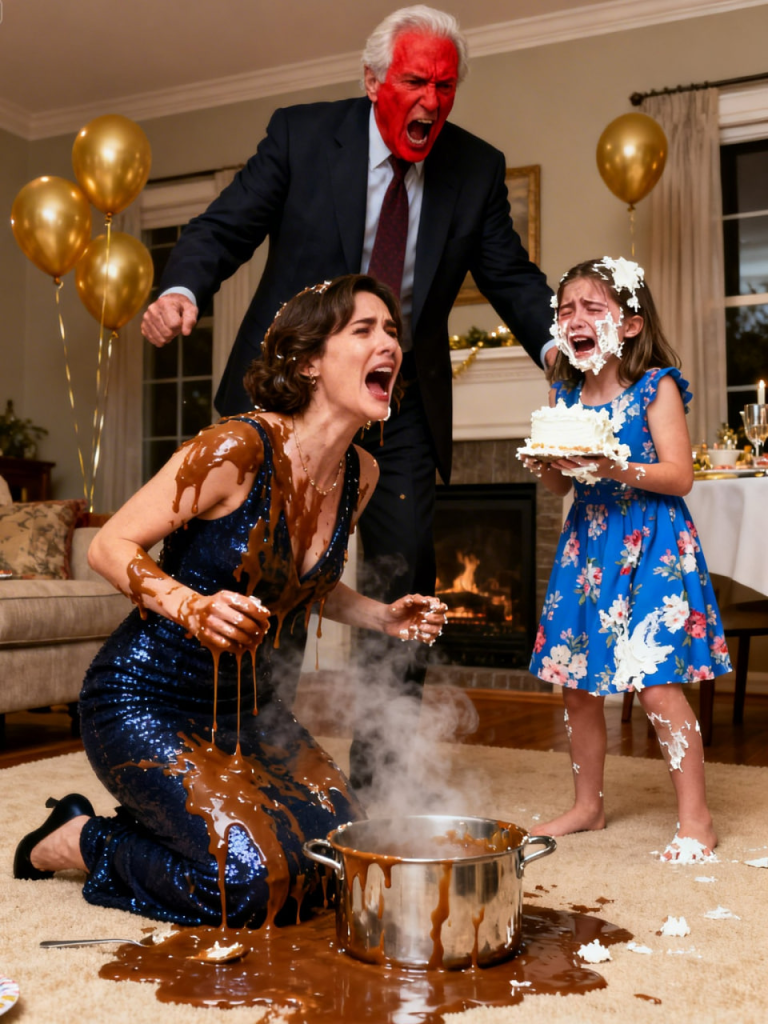
My parents’ anniversary party smelled like sugar, gravy, and old resentments that never die—just get reheated and served again under nicer tablecloths.
They held it at my father’s house, the one with the white columns out front and the carefully trimmed hedges that screamed we made it, even though most of what they’d “made” came from inheritance, luck, and the unpaid emotional labor of women they trained to smile through bruises.
I stood in the foyer with my daughter’s small hand folded into mine like something precious and breakable.
Maya was eight. She wore a pale yellow dress with a ribbon at the waist because she’d chosen it herself—because she’d wanted to look “like sunshine,” she’d told me in the mirror that morning, twirling once and giggling, her curls bouncing.
I’d smiled back and tucked a stray curl behind her ear.
We’ll be sunshine, I’d thought. Even in their shadows.
My mother’s laugh rang out from the dining room, bright and sharp as cut crystal. My father’s voice followed—deep, proud, practiced. The house was full, packed with relatives who only appeared when there was food, photos, and the chance to measure themselves against someone else.
My aunt Beverly—my mother’s sister—glided past in pearls and perfume, trailing her daughter, Serena, like Serena was a crown she’d polished for this exact moment.
Serena was seventeen now, tall and sleek and bored. She looked like my mother when my mother still believed the world would adore her forever.
“Look who finally made it,” Beverly said, stopping in front of me like she’d been waiting at the end of a runway.
Her smile was so sweet it made my teeth ache.
“Hi, Aunt Bev,” I said evenly.
Beverly’s gaze dropped to Maya. “Oh! And this must be little Maya.”
Maya smiled politely. “Hi.”
Beverly tilted her head. “You got so big. Like a little helper, aren’t you?”
Maya’s smile brightened. “I like helping!”
“Good,” Beverly said, and her eyes flicked to my mother’s direction. “Because Serena could really use a hand today. You know—running plates, refilling drinks, that sort of thing. She’s been so busy with scholarship applications.”
Serena’s mouth twisted into something between a smirk and a yawn. “Yeah. Busy.”
I felt Maya squeeze my hand, eager. “I can help!”
I knelt so my face was level with hers. “Sweetheart, you can help me first, okay? We’ll see later.”
Maya nodded, trusting as always.
That trust was the most dangerous thing a child can offer a family like mine.
Inside the dining room, the table was a long stretch of polished wood covered in linen and candles—more for the photos than the atmosphere. My mother presided at the center like a queen on her throne, wearing a champagne-colored dress and a smile that never touched her eyes.
My father stood behind her chair, hands on her shoulders, playing the role of devoted husband with the ease of a man who had rehearsed it for decades.
When he spotted me, his expression shifted—briefly, almost imperceptibly—like someone noticing a stain.
“Caroline,” he said, using my full name like a warning.
“Dad,” I replied. “Happy anniversary.”
My mother stood and kissed the air near my cheek. “You came.”
“I said we would.”
She looked past me. “And Maya, of course. There’s my girl!”
Maya smiled, stepping forward. My mother’s hand landed on Maya’s shoulder with a possessive gentleness.
“There you are,” my mother cooed. “Come show Grandma how pretty you look.”
Maya beamed.
And I watched, because I never let Maya out of my sight in this house.
It wasn’t paranoia. It was pattern recognition.
Dinner began the way it always did—prayers that were more performance than faith, compliments laced with barbs, laughter that came too loud when someone else looked uncomfortable.
My cousin Jonah told a story about his promotion. Aunt Bev bragged about Serena’s “Ivy-level potential.” My mother soaked it all in like sunlight.
Maya sat beside me, swinging her legs quietly, focused on her roll and butter like it was the most important thing in the world.
And maybe it was, because bread had never betrayed her.
Halfway through dinner, my father stood and tapped his glass.
Conversations quieted in waves.
He cleared his throat like he was about to announce a pregnancy or a tragedy—both things that made my family temporarily human.
“My beautiful wife,” he began, laying a hand on my mother’s shoulder again. “Thirty-five years.”
Everyone clapped. My mother lowered her lashes as if humility was an accessory.
“I wanted tonight to be special,” my father continued, voice warm. “Not just for us, but for our family. For the legacy we’ve built.”
I felt my stomach tighten around the word legacy.
Legacy, in my family, was always code for control.
“And because we’ve been blessed,” he said, “we’ve decided to make an announcement.”
The room leaned forward.
I felt Maya shift beside me, curious.
My father smiled at Serena. “Serena, sweetheart—stand up.”
Serena blinked, surprised, then rose slowly, smoothing her dress.
My aunt Beverly’s face shone with triumph.
My father’s voice grew thicker, more ceremonial. “Your grandmother and I have been thinking about the future. About who will carry this family’s name forward with dignity, intelligence, and… responsibility.”
He paused, letting the words hang.
My mother dabbed the corner of her eye with a napkin.
My father continued, “So we’ve decided to gift Serena the house.”
The room erupted.
Gasps, claps, delighted laughter.
Beverly pressed a hand to her chest like she’d been shot with joy.
Serena’s eyes widened. “Wait—seriously?”
My father chuckled. “Seriously.”
My mother stood and hugged Serena tightly.
Then my father added, casually, like it was just a garnish: “And we’ve established a trust for her as well. Two hundred and eighty thousand dollars, to help her with school and a good start.”
The room cheered again.
My mother kissed Serena’s cheek. “Our girl,” she whispered, loud enough for everyone to hear.
I sat perfectly still.
Maya’s small hand found my arm under the table.
“Mom,” she whispered, “what’s a trust?”
I forced a smile. “It’s money saved for someone’s future.”
Maya’s eyes sparkled. “Like a piggy bank?”
“Something like that.”
Maya considered. “Do I have a piggy bank money?”
I swallowed. “We have savings. We’re okay.”
Maya nodded, satisfied, because children believe what love tells them.
Across the table, Beverly leaned toward Serena and whispered something, laughing. Serena covered her mouth, giggling like she’d won a game.
My father raised his glass again. “To Serena—our future.”
Glasses clinked.
And that’s when it happened.
It wasn’t a dramatic explosion. It was quiet. Almost casual.
My uncle Hank—my father’s brother—leaned back in his chair, looking at Maya the way people look at furniture they don’t like.
He chuckled and said, “Well, Serena’s got the house and the trust. Guess that means she’ll need someone to keep it clean.”
A few people laughed uncertainly.
My aunt Beverly smiled like she knew where this was going.
Uncle Hank nodded toward Maya. “That’s what cousins are for, right? Little cousin’s slave.”
The word hit the room like a slap.
For a second, everything froze—not because they were horrified, but because they were gauging the weather. Waiting to see if the queen would approve the joke.
My mother’s lips twitched.
My father’s eyes narrowed—not in anger, but in calculation.
Then my mother laughed.
A light, tinkling laugh that gave everyone permission.
“Oh, Hank,” she said, waving a hand. “Don’t be so dramatic.”
Beverly laughed too. “He’s kidding.”
Serena smirked, looking at Maya. “Yeah, relax.”
Maya blinked, confused.
She looked at me, eyes wide. “Mom?”
My throat tightened so hard it hurt.
I could have stood up right then. I could have thrown my napkin down. I could have screamed.
But in my family, screaming only ever made you the problem.
I had learned, the hard way, that if you want to win against people like this, you don’t give them your emotions.
You give them consequences.
So I did what they least expected.
I stayed silent.
I reached under the table and squeezed Maya’s hand gently, grounding her without giving them a show.
Then I looked up—straight at my mother—and smiled.
Not big. Not sweet.
Just enough to be unsettling.
My mother’s laughter faltered.
She tilted her head, eyes narrowing slightly, like she sensed a shift but couldn’t name it.
I rose calmly from my chair.
The room quieted again, because people always pay attention when the “reasonable one” stands.
I picked up my glass.
“Happy anniversary,” I said, voice smooth.
Everyone smiled, relieved.
My mother relaxed.
Then I turned my gaze toward Serena.
“And congratulations,” I added. “On the house. On the trust. On being the family’s chosen future.”
Serena lifted her chin, smug. “Thanks.”
I nodded once. “You’ll need it.”
A few people laughed, thinking I was being supportive.
I set my glass down and sat again.
And the party rolled on.
They thought that was it.
They thought my silence was surrender.
It wasn’t.
It was strategy.
Because there was one truth this family feared more than any argument.
And I was done protecting it.
That night, after we got home, Maya stood in her doorway in her pajamas, hair still smelling like the cheap strawberry shampoo she loved.
“Mom?” she asked softly.
I looked up from the kitchen table, where I’d been staring at nothing for ten minutes.
“Yes, baby.”
Maya hugged her stuffed bunny tighter. “What does slave mean?”
My chest tightened.
I got up and crossed the hallway to kneel in front of her.
“It’s a very bad word,” I said carefully. “It means someone thinks they own another person. It’s not true. And no one gets to call you that.”
Maya’s eyes filled. “Why did they say it?”
Because they could.
Because they’d been practicing cruelty on me for years, and now they were passing it down like an heirloom.
I brushed her cheek with my thumb. “Some people say ugly things when they feel powerful. But it doesn’t mean you’re small. It means they are.”
Maya sniffed. “Am I in trouble?”
“No,” I said firmly. “Never.”
She hesitated. “Do they… not like me?”
I swallowed hard. “They don’t know how to like people unless they can control them.”
Maya’s brow furrowed. “Do you like me?”
I smiled, and this time it was real. “More than anything in the whole world.”
She leaned into me, and I held her tighter than I meant to.
After she fell asleep, I sat in my living room with my laptop open, the glow painting my hands pale.
I didn’t go looking for revenge right away.
I went looking for truth.
Because I had been holding something for years—something my family had forced into my hands like a burning coal and then told me to smile through the smoke.
A secret.
A history.
A lie with a pulse.
It started when I was sixteen.
Back then, my father wasn’t the polished patriarch everyone toasted. He was a man with a temper and an appetite for control. My mother wasn’t the glittering social hostess—she was a woman who’d learned how to survive by aligning herself with power, even when it meant sacrificing her children.
And I—Caroline—was the daughter who looked too much like the wrong person.
My hair was darker than my mother’s. My eyes weren’t my father’s. I had my mother’s stubbornness but none of her charm.
My mother used to say, “You’re lucky your father loves you anyway,” like love was something you earned through silence.
When I was sixteen, I found a letter in the attic.
It was in a box labeled Holiday Cards, tucked under old ornaments.
The envelope was yellowed, sealed, and addressed to my mother in a handwriting I didn’t recognize.
I opened it because I was a teenager, because curiosity is a kind of hunger, and because my family’s secrets always felt like they were pressing against the walls.
The letter wasn’t romantic.
It was desperate.
It said: Caroline is his.
It said: Please stop pretending she isn’t.
It said: I won’t stay quiet forever.
There was a name at the bottom: Evan Mercer.
I didn’t know who Evan Mercer was—until I did.
Because later that year, I saw him in a photograph tucked behind my mother’s jewelry box.
A man with dark hair and a soft smile, arm around my mother in a way my father never held her.
I confronted my mother, shaking, with the letter in my hand.
Her face went pale.
Then her eyes went cold.
She slapped me.
Not hard enough to bruise, but hard enough to teach.
“Where did you get that?” she hissed.
“In the attic,” I whispered.
My mother snatched the letter and tore it in half. Then in half again. Then again, until it was confetti.
“You never saw that,” she said.
“Who is he?” I cried.
My mother’s voice dropped low, like venom. “He is nobody. And you will not bring this into our home.”
“But—”
She grabbed my face, nails digging slightly into my cheeks. “Listen to me. Your father is your father. He raised you. He provides. He gives you a life you don’t deserve. If you ever threaten that—if you ever embarrass us—he will destroy you. And I will not save you.”
I remember the way her eyes looked.
Not loving.
Not protective.
Survivalist.
That was the moment I learned what my mother worshipped.
Not family.
Not truth.
Appearance.
I buried the secret because I was sixteen and afraid and because I still wanted my mother to love me.
But secrets don’t stay buried.
They ferment.
They rot.
They turn into resentment that shows up at anniversary dinners when your child gets called a slave and your mother laughs.
Over the years, more pieces fell into place.
My father never treated me like Jonah. Never treated me like Serena. I was the daughter he tolerated—useful for photos, for appearances, for the narrative of a “complete family.”
When I got pregnant with Maya at twenty-one—unplanned, terrifying, beautiful—my father almost disowned me.
“You will not embarrass this family,” he’d snarled.
I left, then.
I scraped by. I worked two jobs. I built a life where no one could make my daughter feel small.
And when I returned—years later, after my divorce and my job loss—my family welcomed me back with smiles that tasted like debt.
Because in their minds, I’d come crawling.
But I hadn’t.
I’d come watching.
And tonight, at that table, they’d aimed their cruelty at Maya the way they’d aimed it at me.
That was the line.
I opened my laptop and searched my old emails, my old scanned documents.
Because over the years, I hadn’t just buried the truth.
I’d collected it.
Quietly.
Like insurance.
There were hospital records from when I was born—my father wasn’t listed as the one who signed the release.
There were family photos with dates. There were notes from my grandmother—my father’s mother—who had once cornered me at twelve and said, “You don’t look like us,” like it was a crime.
And then there was the biggest piece of all:
A DNA test.
Not mine.
My father’s.
Three years ago, my father had gotten sick. Not seriously—just enough to frighten him into medical tests. He’d done genetic screening as part of it, the kind that went into family risk factors.
My mother had asked me to help her organize his medical files because she hated paperwork.
While sorting, I’d found the results.
Blood type. Genetic markers.
And a note: Paternity not confirmed without additional testing.
It wasn’t a confession, but it was a crack.
A crack big enough to pry open if you were careful.
And I had been careful.
Because I’d done my own test later. Through a reputable lab. Quietly. Without telling anyone.
And the results sat in my email like a loaded gun.
Not biologically related to presumed father.
I stared at the screen until my eyes burned.
The truth they feared was simple:
My father’s perfect “legacy” wasn’t his.
And I—his least favorite child—was living proof.
I didn’t want to expose it. Not for my sake. Not even for revenge.
But they had come for my daughter.
And I realized something that night:
If you let people like this keep their secrets, they use them like weapons.
If you take the secret away, they’re just people.
Small, scared people behind white columns.
So I made a plan.
The next morning, my mother called me.
Her voice was syrupy. Too sweet. Always a warning.
“Caroline,” she said, “I’ve been thinking about last night.”
“Oh?” I replied.
“I don’t want any… misunderstandings,” she said. “Hank was joking. You know how he is.”
“I know exactly how he is,” I said.
A pause.
Then my mother’s voice sharpened slightly. “Don’t create drama, Caroline.”
I smiled, though she couldn’t see it. “I’m not creating anything.”
Another pause—longer this time.
“Serena will be expecting help,” my mother said. “She’s going to be busy with school and planning. It would be nice if Maya could come over sometimes. Learn responsibility.”
There it was.
The grooming.
Turning “slave” into “responsibility.”
I kept my voice calm. “Maya has responsibilities. She’s eight. Her responsibility is being a child.”
My mother sighed dramatically. “You’re so sensitive.”
“No,” I said. “I’m specific.”
My mother’s tone turned cold. “You should be grateful we’re still family.”
My fingers tightened around the phone. “Family doesn’t call children slaves.”
Silence.
Then my mother said, quietly, “Be careful.”
The threat was subtle, but it was there.
As if she could still scare me the way she did when I was sixteen.
I ended the call politely.
Then I drove to the one person my family never accounted for:
My grandmother’s old lawyer, Mr. Danner.
He was retired now, but his office still operated under his name, run by a younger partner who had once been his assistant.
I sat in the waiting room with my folder of documents and my hands steady.
When the partner, Ms. Keene, called me in, I felt something settle in my bones.
This wasn’t just emotional.
This was legal.
This was about the trust, the house, and the way my father had always used money as a leash.
I didn’t want their money.
But I did want them to stop using it to crown cruelty.
Ms. Keene listened as I explained—carefully, without dramatics.
My father gifting Serena the house and a $280,000 trust. The way they treated my daughter. The family’s patterns.
Then I slid one document across her desk: my DNA test result.
Her eyes narrowed as she read.
“This is… significant,” she said slowly.
“Yes,” I replied. “And it’s real.”
Ms. Keene leaned back. “What are you hoping to accomplish?”
I thought about Maya’s face when she asked what slave meant.
“I want them to stop,” I said. “And if they won’t stop, I want the truth to stop them.”
Ms. Keene nodded once. “Truth can be powerful. But it can also be messy.”
“I can handle messy,” I said. “My whole life has been their mess. I’m just done cleaning it.”
Ms. Keene folded her hands. “If your father is not your biological father, it may affect certain inheritance assumptions—depending on how wills and trusts are written. But it doesn’t automatically undo gifts.”
“I’m not trying to undo gifts,” I said. “I’m trying to stop them from using gifts to reward abuse.”
She studied me. “Then your best leverage is not the money. It’s the reputational risk.”
Exactly.
My family didn’t fear courts as much as they feared whispers.
They feared the country club, the church, the charity board.
They feared being seen.
Ms. Keene said, “If you choose to disclose this publicly, you should do it carefully. You need proof that can withstand challenge. A private DNA test might not be enough.”
“I can get more,” I said.
She nodded. “And you should understand: once it’s out, you can’t put it back.”
I pictured my mother’s face. My father’s fury. Beverly’s scandalized gasp. Serena’s smugness evaporating.
I pictured Maya, small in a yellow dress, being called a slave.
“I’m not putting it back,” I said.
Two weeks later, my father hosted another gathering.
This one wasn’t an anniversary. It was a “celebration” for Serena’s new future—an excuse to parade the gift and bask in praise.
A realtor came to talk about renovations. A financial advisor chatted about the trust. My mother glowed like she’d personally invented generosity.
They invited half the neighborhood, the pastor, and my father’s business partners.
They wanted an audience.
I gave them one.
I arrived with Maya, again in a bright dress, again holding my hand.
This time, Maya didn’t smile eagerly.
She stayed close, watching faces like she was learning which ones were safe.
That broke something in me.
Because children shouldn’t have to develop survival skills at family parties.
As we entered, my mother kissed my cheek with more force than warmth.
“I’m glad you came,” she said.
Her eyes warned: Behave.
I smiled back. “Wouldn’t miss it.”
Beverly swept in, pearls flashing. “Caroline! There you are.”
She glanced down at Maya. “And the little helper.”
Maya stiffened.
I put a hand on Maya’s shoulder. “Maya’s here to enjoy herself,” I said lightly. “Like everyone else.”
Beverly’s smile tightened. “Of course.”
Across the room, Serena stood with a group of teenagers, laughing, phone in hand. When she saw Maya, she waved lazily.
“Hey,” Serena called. “Maya! Come here.”
Maya looked up at me, uncertain.
I knelt. “You don’t have to go anywhere you don’t want,” I whispered.
Maya nodded.
Serena rolled her eyes and turned back to her friends.
The party moved like a machine—small talk, compliments, flattery. My father soaked it in like it was oxygen.
At one point, the pastor shook my father’s hand and said, “Such a blessing, to provide for the next generation.”
My father smiled. “Family comes first.”
I almost laughed.
Instead, I waited.
Because I wasn’t going to explode.
I was going to reveal.
When my father tapped his glass again to give a speech, I felt the room settle into attention.
He talked about Serena’s future. About responsibility. About values. About the “legacy” of our name.
Then he raised his glass to toast.
“And to family,” he said.
Glasses rose.
That’s when I stood.
The clink of my chair against the floor was small, but it cut through the room like a blade.
Heads turned.
My father’s smile faltered. “Caroline?”
I lifted my glass. “I’d like to add something.”
A few people chuckled politely.
My mother’s eyes narrowed.
I looked around the room—at the neighbors, the pastor, the business partners, the relatives.
Then I looked at my father.
“You keep using the word legacy,” I said calmly. “And I think it’s important we’re honest about what that legacy is.”
My father’s jaw tightened. “This isn’t the time.”
“Oh,” I said, voice gentle. “I think it is. Because you’ve made this a public celebration. And public celebrations deserve public truth.”
My mother’s face went pale.
Beverly’s smile froze.
I reached into my purse and pulled out an envelope.
I didn’t wave it dramatically. I simply held it, like a fact.
My father’s eyes flicked to it, and for a second—just a second—I saw fear.
Not anger.
Fear.
I continued, “When I was sixteen, I found a letter addressed to Mom. A letter from a man named Evan Mercer.”
The room shifted. People exchanged glances. The pastor’s eyebrows lifted slightly.
My mother whispered, “Caroline, stop.”
I didn’t look at her.
“That letter said something very simple,” I said. “It said, ‘Caroline is his.’”
My father’s face darkened. “Enough.”
I smiled politely. “Not yet.”
I took a breath. My voice remained steady—because I had practiced this. In the mirror. In my car. In the quiet moments after Maya fell asleep.
“I’ve lived my entire life being treated like an outsider in my own family,” I said. “And last week, at the anniversary dinner, someone called my eight-year-old daughter a ‘cousin’s slave.’”
A murmur rippled. Several people looked uncomfortable. The pastor’s face tightened.
My aunt Beverly’s voice snapped, “That was a joke—”
“A joke,” I repeated, still calm, “that was laughed at by my mother.”
My mother’s lips parted, trembling.
I glanced at her briefly. “So I decided I was done staying quiet.”
I held up the envelope. “Inside this envelope is a certified DNA result.”
A heavier silence dropped.
I looked directly at my father.
“It confirms,” I said, each word careful, “that you are not my biological father.”
Gasps.
My father’s face went a shade I’d never seen—like rage and panic were fighting for dominance.
My mother made a small sound, like a breath being strangled.
Beverly’s hand flew to her chest.
Someone whispered, “Oh my God.”
Serena’s face drained of color. Her friends stared at her, wide-eyed, phones halfway raised.
The pastor blinked, then lowered his glass slowly.
My father stepped forward, voice low and dangerous. “You are lying.”
I nodded once. “I’m not.”
My mother surged toward me, eyes wild. “Caroline—please—”
I held up a hand gently, stopping her without touching her. “No. You don’t get to ‘please’ me now.”
My father’s business partner—Mr. Halbrook—shifted uncomfortably. “Robert—”
My father snapped, “Stay out of this.”
I looked at the room again. “For years, this family has used money, gifts, and status to control people. To silence people. And when that didn’t work, they used cruelty.”
I looked down at Maya, who stood beside me, holding my hand tightly, eyes huge but steady.
“This,” I said, “is why they feel comfortable calling a child a slave. Because they believe they own the narrative.”
I lifted my glass slightly. “Not anymore.”
My father lunged—just one step—then stopped, because he remembered the audience.
My mother’s face crumpled. “You’re destroying us.”
I stared at her, and my voice softened—not with mercy, but with truth. “You destroyed us when you decided appearance mattered more than your children.”
Beverly sputtered. “This is disgusting—airing this out—”
“No,” I said quietly. “What’s disgusting is laughing at a child being dehumanized.”
Serena finally found her voice, shrill with fury. “Why are you doing this? You’re jealous! You just want the money!”
I looked at her—this girl crowned with a house and a trust.
Then I said the one thing that made her flinch.
“I don’t want your money,” I replied. “I want you to stop thinking money makes you better.”
Serena’s mouth opened, then closed.
My father’s eyes burned. “Get out.”
I nodded, still calm. “We will.”
I turned to the room, lifting my glass one last time.
“To truth,” I said.
Then I set the glass down gently, took Maya’s hand, and walked out.
Behind me, the party erupted—not into celebration, but into chaos.
Shouts. Accusations. People leaving quickly. The pastor murmuring something to his wife. Mr. Halbrook staring at my father like he’d never seen him before.
I didn’t look back.
Because my whole life, I’d been looking back, trying to earn a place.
I was done.
The fallout was swift, because gossip travels faster than morality.
By the next morning, my phone was buzzing with texts:
Is it true?
What happened last night?
Your mom is devastated.
Your dad says you’re lying.
The pastor wants to “talk.”
My father called three times. My mother left a voicemail sobbing and begging. Beverly sent a long message calling me “evil.”
I didn’t respond.
I forwarded the certified DNA result to Ms. Keene, along with a summary of what I’d said and who was present.
Then I did the next thing my family never expected:
I filed a report.
Not for the DNA. For the child.
For the “slave” comment.
For the hostile environment.
For the pattern of harassment.
Because whether the law cared or not, documentation matters when people try to rewrite reality.
My father’s lawyer sent a letter threatening defamation.
Ms. Keene responded with a short, sharp reply: Truth is a defense. Attempts at intimidation will be noted.
My father’s world began to crack.
Not because everyone suddenly became righteous—my family’s social circle wasn’t built on righteousness.
But because people hate uncertainty.
If my father’s “legacy” had a question mark, then his image did too.
And image was his currency.
Mr. Halbrook “postponed” a business deal. The charity board delayed a vote. The pastor asked my parents to “take a step back” from leadership until things “settled.”
My mother was furious—not at my father for lying, not at herself for protecting it.
At me.
She came to my apartment unannounced one afternoon, eyes swollen, face set like stone.
I opened the door and stepped outside, closing it behind me so Maya wouldn’t hear.
My mother’s voice shook with rage. “How could you humiliate us like that?”
I stared at her. “How could you laugh when they called Maya a slave?”
My mother flinched. “It was a joke.”
“It was cruelty,” I corrected.
My mother’s lips trembled. “You could have handled this privately.”
I laughed once, bitter. “Privately? Like you handled it privately when I was sixteen? With a slap and a threat?”
Her eyes widened.
I continued, voice low, “You told me Dad would destroy me. You told me you wouldn’t save me. You trained me to be quiet.”
My mother’s jaw tightened. “You don’t understand what I’ve endured.”
“Oh,” I said softly, “I understand exactly what you endured. I endured it too. The difference is—you made me pay for it.”
My mother’s eyes filled. “Robert will leave me.”
I stared at her. “Maybe you should let him.”
She looked like I’d slapped her.
“Mom,” I said, voice steady, “you came here worried about your marriage. I came here worried about my child’s dignity. Do you hear the difference?”
My mother sobbed, covering her mouth.
For a moment, I almost reached for her.
Then I remembered Maya’s question in her doorway: Do they not like me?
And I stayed where I was.
“I’m not doing this to hurt you,” I said quietly. “I’m doing this because you refused to stop them from hurting us.”
My mother’s shoulders shook. “What do you want?”
I looked her in the eye. “An apology to Maya. A real one. In front of the same family who laughed. And I want boundaries. No more access to my child if you can’t protect her.”
My mother stared, horrified. “You’d keep her from me?”
“I’ll keep her safe,” I said. “That’s my job.”
My mother wiped her face, shaking. “You’re cruel.”
I shook my head. “No, Mom. I’m just done being convenient.”
She left without another word.
Two months later, my father did what he always did when threatened: he tried to buy control.
He offered me money.
A “settlement,” he called it. A private conversation arranged through an attorney. A check with enough zeros to tempt a struggling single mother.
Ms. Keene showed me the offer in her office.
I stared at it and felt something in my chest twist—not desire, but disgust.
“He thinks this fixes it,” I said.
Ms. Keene nodded. “He thinks this buys your silence.”
I looked up. “If I take it, he wins.”
“If you take it,” she said carefully, “you secure your daughter’s future.”
I thought of Maya’s yellow dress. Her small hand in mine. Her trust.
Then I thought of my father’s toast: To family.
I slid the paper back. “My daughter’s future is not built on hush money.”
Ms. Keene studied me, then nodded once. “Okay.”
We sent a response: no.
My father’s retaliation came fast.
He told the family I was unstable. That I’d fabricated the DNA. That I was bitter and trying to destroy them because I was jealous of Serena.
Beverly spread it like gospel.
But lies don’t land the same when the truth has receipts.
Because I did one more thing:
I found Evan Mercer.
It wasn’t easy. His name was common enough to be a maze.
But I had the letter’s old return address—burned into my memory from sixteen—and after some digging, public records, and one careful phone call, I found him.
He was older now. Grayer. He lived two towns away in a modest house with wind chimes on the porch.
When he opened the door and saw me, he didn’t look surprised.
He looked… guilty.
“Caroline,” he said softly, like he’d said my name in his head a thousand times.
My throat tightened. “Hi.”
He blinked rapidly. “You—You found me.”
“Yes,” I said. “I did.”
He stepped back, letting me in.
His house smelled like coffee and old books. There were no white columns. No polished furniture. Just warmth.
He offered me tea with hands that trembled slightly.
Then we sat across from each other, and I told him what happened.
The party. The trust. The “slave” comment. The DNA result.
Evan’s face crumpled slowly as if the weight of decades finally landed.
“I tried,” he whispered. “I tried to be there. Your mother—she—she chose him. She chose the life.”
“I know,” I said.
He swallowed hard. “I never stopped thinking about you.”
I stared at him. “Why didn’t you fight?”
His eyes filled. “Because I was weak. Because your father threatened me. Because I believed your mother when she said you’d be safer if I disappeared.”
My jaw clenched. “Safer.”
Evan flinched. “I’m sorry.”
I sat in silence for a long moment.
I didn’t come here for a new father.
I came here for the final nail in the coffin of their lie.
“I need you to write a statement,” I said.
Evan blinked. “A statement?”
“Yes,” I replied. “That you are my biological father. That you wrote the letter. That my mother knew.”
Evan’s hands shook. “Caroline—this will destroy her.”
I looked at him, steady. “She destroyed me.”
Evan’s eyes spilled over. “I know.”
He nodded slowly. “Okay.”
He wrote it that night.
Signed it. Notarized it the next day.
When I left his house, I didn’t feel healed.
But I felt armed.
The final confrontation happened in court.
Not because I sued for the house or the trust—I didn’t.
It happened because my father tried to.
He filed an emergency petition claiming I was defaming him and “endangering the family’s reputation,” as if reputation were a legal child protection concern.
He wanted a gag order.
He wanted to silence me.
And in doing so, he walked straight into the only arena where lies have a harder time surviving: the record.
In court, my father sat stiffly in his suit, jaw clenched, eyes burning with hate he tried to disguise as disappointment.
My mother sat beside him, pale and rigid, like she’d been carved.
Beverly sat behind them, clutching Serena’s hand like Serena was the one who needed comfort.
Serena looked rattled—less smug now, more aware that she’d inherited a throne built on rot.
Ms. Keene stood beside me.
Maya wasn’t there. She was at school. Safe. Unused as a prop.
The judge listened as my father’s lawyer spoke about “irreparable harm” and “false allegations.”
Then Ms. Keene stood.
She presented the DNA certification.
She presented Evan Mercer’s notarized statement.
She presented the old hospital record signature discrepancy.
And then—because the judge asked for context—she explained the incident with my daughter.
“The petitioner’s family,” Ms. Keene said evenly, “called an eight-year-old child a ‘cousin’s slave’ in a public gathering, and laughed. My client disclosed family truth after years of intimidation. That is not defamation. That is disclosure.”
The judge’s expression tightened.
My father’s lawyer sputtered.
My father’s face went red.
The judge asked my father directly, “Are you the biological father of the respondent?”
My father’s jaw clenched.
My mother’s eyes squeezed shut.
My father finally snapped, “It doesn’t matter. I raised her.”
The judge’s gaze sharpened. “It matters when you’re asking this court to restrict speech based on falsehood.”
My father’s lawyer tried to pivot.
The judge wasn’t interested.
He denied the petition.
No gag order.
No silencing.
And then—something I hadn’t expected—he added, “I suggest the parties address this privately and with professional help.”
My father glared at me as if he could burn me with his eyes.
But he couldn’t.
Not anymore.
Outside the courtroom, Beverly hissed, “You’ve destroyed this family.”
I looked at her calmly. “No. I exposed it.”
Serena’s eyes met mine, flickering with something—fear, maybe. Or shame.
My mother stepped forward, trembling.
“Caroline,” she whispered.
I turned to her.
My mother’s voice broke. “Do you… hate me?”
The question was so raw it almost sounded human.
I held her gaze.
“I hate what you did,” I said softly. “I hate what you allowed. But I don’t hate you.”
My mother sobbed.
“And because I don’t hate you,” I continued, “I’m giving you one chance to do the right thing.”
She looked up, hopeful and terrified.
“Apologize to Maya,” I said. “In person. And tell the family—clearly—that she is not to be treated as anyone’s servant, helper, or joke. If you can’t do that, you won’t see her.”
My mother’s lips trembled. She glanced at my father.
My father’s eyes were hard.
My mother inhaled, shaking.
Then she nodded.
“I will,” she whispered. “I will.”
My father snapped, “Don’t you dare—”
My mother turned to him with a sudden fierceness that made even me blink.
“Enough,” she said.
My father froze, stunned.
My mother looked back at me, tears streaming. “I will.”
Two weeks later, my mother came to my apartment alone.
No pearls. No performance.
Just a woman who looked older than her years.
Maya sat on the couch with her bunny, wary.
My mother knelt in front of her.
“Maya,” she said softly, voice trembling, “I need to say something to you.”
Maya stared.
My mother swallowed hard. “What Uncle Hank said was wrong. What everyone did—laughing—was wrong. You are not a slave. You are not anyone’s helper unless you want to be. You are a little girl who deserves respect.”
Maya’s eyes flicked to me, seeking confirmation.
I nodded gently.
My mother’s voice broke. “I’m sorry I didn’t protect you. I should have.”
Maya stared for a long time, quiet.
Then she whispered, “Why didn’t you?”
My mother’s face crumpled. “Because I was scared. And because I was weak. And because I forgot that grown-ups are supposed to be brave for kids.”
Maya considered that, serious as only children can be.
Then Maya said softly, “My mom is brave.”
I felt tears rise fast and hot.
My mother nodded, sobbing quietly. “Yes. She is.”
After my mother left, Maya climbed into my lap and pressed her face into my shoulder.
“Mom,” she whispered, “are we okay?”
I held her tight. “We are more than okay,” I whispered back. “We’re free.”
And we were.
Because the truth they feared wasn’t just about biology.
It was about power.
My father’s power had always depended on silence.
My mother’s survival had always depended on denying.
Beverly’s pride had always depended on hierarchy.
Serena’s throne had always depended on being chosen.
But once the truth was out, the hierarchy looked ugly.
The money looked like a muzzle.
The white columns looked like a set.
And my daughter—my sunshine—was no longer a target.
My father still has his house for now. Serena still has her trust. I didn’t take those things away.
I took away something they valued more:
The story that they were good.
The illusion that they were untouchable.
The comfort of thinking their cruelty would never cost them anything.
Because now, every time my father tries to toast to “family,” he has to remember the day his legacy cracked in front of an audience.
And every time my mother looks at my daughter, she has to choose: repeat the past, or protect the future.
As for me?
I stopped staying silent.
Not because I wanted to destroy them.
But because I wanted to build something my daughter could live inside without shrinking.
And the one truth they feared?
It wasn’t just that my father wasn’t my father.
It was that I was no longer theirs to control.

Leave a Reply