The house smelled like roasted turkey and cinnamon when I pushed open the front door, the kind of warm, homey scent that used to mean comfort.
But that night, it felt wrong somehow—too heavy, too staged, like walking into a memory that didn’t belong to me anymore.
The October wind followed me in for a moment, chilling my ankles before the door swung shut behind me. I stood in the narrow foyer, one hand under my belly, the other clutching my purse, breathing slow because even small movements were hard these days. Eight months pregnant meant everything was an event: stepping over shoes, bending to pick up a dropped key, twisting to close a door. My body felt like it had its own gravity.
From the living room came the bright rise and fall of voices—laughter, clinking glasses, the over-the-top sing-song of relatives who only remembered you when there was something to celebrate. I hadn’t heard those sounds around me in almost two years. Not since I stopped showing up and let the quiet do what it always did: swallow me whole.
“Claire?” my mother called, like she wasn’t sure it was me.
I stepped forward, and the hardwood creaked under my flats. I’d chosen the only pair that didn’t squeeze my swollen feet. My coat was unbuttoned because nothing buttoned anymore. My hair was pulled back because I couldn’t handle it brushing my neck. I looked, in other words, exactly like what I was: a woman who had spent the last eight months being poked and prodded by life and doctors and strangers’ opinions and still somehow had the nerve to show up at a family reunion where she wasn’t wanted.
My mother appeared in the doorway, wiping her hands on a dish towel as if she’d been caught doing something messy. She paused, eyes flicking to my stomach, then back to my face.
“Oh,” she said, and the word carried everything my family ever offered me—surprise that I existed, annoyance that I took up space, and a pinch of performance. “You made it.”
“I said I would,” I answered, as gently as I could manage.
Behind her, the living room glowed. The fireplace was lit even though it wasn’t cold enough. A charcuterie board the size of a car tire sat on the coffee table. Someone had put out those little pumpkin-shaped candles that always smelled like fake sugar. It was cozy in the way home magazines were cozy: curated, camera-ready, not a crumb out of place.
And then my sister Jenna swept into view, carrying a tray of something glossy and browned. She wore an apron that said Bless This Mess in glittery cursive. Of course she did.
“Claire!” she chirped like we were best friends who’d had a cute little misunderstanding. Her smile widened as she glanced at my belly. “Wow. You’re… huge.”
There it was. The first jab, delivered with the lightness of a feather and the sharpness of a needle. Jenna always did that—she’d wound you and then look offended when you bled.
I forced a smile. “Hi, Jenna.”
She leaned in as if to hug me. I braced, because Jenna’s hugs were never hugs. They were checks: to see how you reacted, how much you’d tolerate, whether you’d flinch. Her arms circled my shoulders lightly, and she whispered near my ear, “I’m so proud of you for coming. I know it must be hard, with everything.”
With everything meant: with your life not matching ours. With you not fitting into the family picture anymore. With you having the audacity to get pregnant when you were the designated screw-up.
She pulled back and patted my belly without asking. “Little miracle,” she said to the room, loud enough for anyone to hear. “We weren’t sure she could even… you know.”
My throat tightened, but I swallowed it down. This was why I’d hesitated to come. Not because I couldn’t handle a comment. I’d handled comments my whole life. It was because once you walked back into that house, you became twelve again, standing in the kitchen while Jenna “accidentally” knocked your juice over and everyone laughed about how clumsy you were.
I’d told myself I was coming for the baby. For the future. For the chance—however slim—that my child might have grandparents, cousins, an aunt who would spoil them at Christmas.
But as Jenna’s hand lingered on my stomach like she was claiming ownership, I felt something colder than the October wind move through me.
I wasn’t walking into a reunion.
I was walking into a stage.
And I’d been cast as the joke.
“Come in,” my mother said, stepping aside. “Everyone’s been asking about you.”
That was also a lie, but it was the kind my mother told like she believed it. Denial was her favorite form of housekeeping.
I walked into the living room and got a chorus of greetings. Aunt Marlene’s eyes flicked immediately to my belly, then to my ring finger. No ring. She clicked her tongue and said, “Well, life takes different paths,” like she was narrating a documentary about bad choices.
Uncle Rob raised his glass. “Look who decided to join civilization again.”
Someone laughed. Not even cruelly. Just automatically. Like laughter was the easiest way to show you knew your role in the family script.
Jenna moved behind the bar cart and started pouring drinks like the hostess of a reality show. Her house, her food, her décor—her spotlight. It wasn’t my mother’s home anymore. Not really. Jenna had moved back in after her divorce, under the guise of “helping Mom,” and now every gathering was Jenna’s set.
I could see it in the details: the matching napkins, the printed menu on the counter, the framed photo collage of Jenna’s wedding—still hanging, even though the man in the pictures hadn’t been around in over a year. Jenna didn’t let go of things that made her look good. She would rather preserve a lie than adjust the frame.
“Where’s Marcus?” Aunt Marlene asked, because of course that’s what people asked. Not How are you feeling? Not Are you okay? But the question that implied my life didn’t count unless it came with a man attached.
“He’s working,” I said.
“Again?” Uncle Rob scoffed. “That guy never shows up.”
“He’s on a job,” I repeated. Marcus was a lineman. Storm season didn’t care about reunions.
Jenna leaned on the bar cart and smiled sweetly. “I told you, Claire. If you needed help, you could’ve just asked. You didn’t have to do… all this… alone.”
It sounded like concern. It was actually a message: You’re alone because you deserve to be.
My cheeks warmed, and for a second I saw myself as they did—a swollen, ringless woman who showed up late to family events and made everyone uncomfortable with her existence.
But then I felt the baby move. A slow roll, like a reminder.
I was not twelve.
And I wasn’t here to beg for a seat.
“I’m okay,” I said. “I just wanted to come.”
My mother clapped her hands too brightly. “Dinner’s almost ready. Claire, you can sit—don’t do anything strenuous.”
Jenna’s eyes flashed, just for a beat. The golden child didn’t like seeing anyone treated gently. Gentleness was supposed to be her reward.
“I can help,” I offered before I could stop myself, because old habits are stubborn things. I’d spent years earning love by being useful.
Jenna’s smile returned, but it changed. It sharpened.
“Oh, sure,” she said, like she’d just been handed a gift. “Actually, you can carry the gravy. It’s in the kitchen.”
Something in my gut—separate from the baby—tightened. Carry the gravy. Why that?
But everyone was watching. The room was filled with faces I’d known my whole life, and every one of them held the same expectation: Don’t make it weird, Claire. Don’t be dramatic. Don’t ruin the vibe.
So I nodded, because I’d been trained to nod.
The kitchen was bright and hot, the oven radiating like an open mouth. Pots simmered on the stove. A turkey rested on a cutting board, glistening under the light. The counter was crowded with side dishes: mashed potatoes, green beans, stuffing, some kind of casserole topped with crispy onions.
Jenna stood by the stove, back to me, stirring something in a saucepan.
“There,” she said, nodding toward a ceramic gravy boat sitting near the edge of the counter. It was filled almost to the top with thick, brown gravy, steam curling up in lazy ribbons.
I hesitated. The gravy looked… too hot. Not just warm. Boiling.
“You just made it?” I asked.
Jenna didn’t turn. “Of course. I’m not serving cold gravy.”
My fingertips hovered near the handle. The ceramic was heavy, and my balance wasn’t great. A small voice in my head said, Ask someone else to carry it. Another voice—louder, older—said, Don’t be difficult.
So I wrapped my hand around the handle.
Heat bit through the ceramic immediately. I yanked my fingers back.
“Jenna, it’s—”
She turned suddenly, her shoulder bumping mine.
The world tilted.
The gravy boat lurched in my grasp. I felt it slipping, tried to steady it, and then Jenna’s hand—quick as a flick—pressed against the bottom, tipping it.
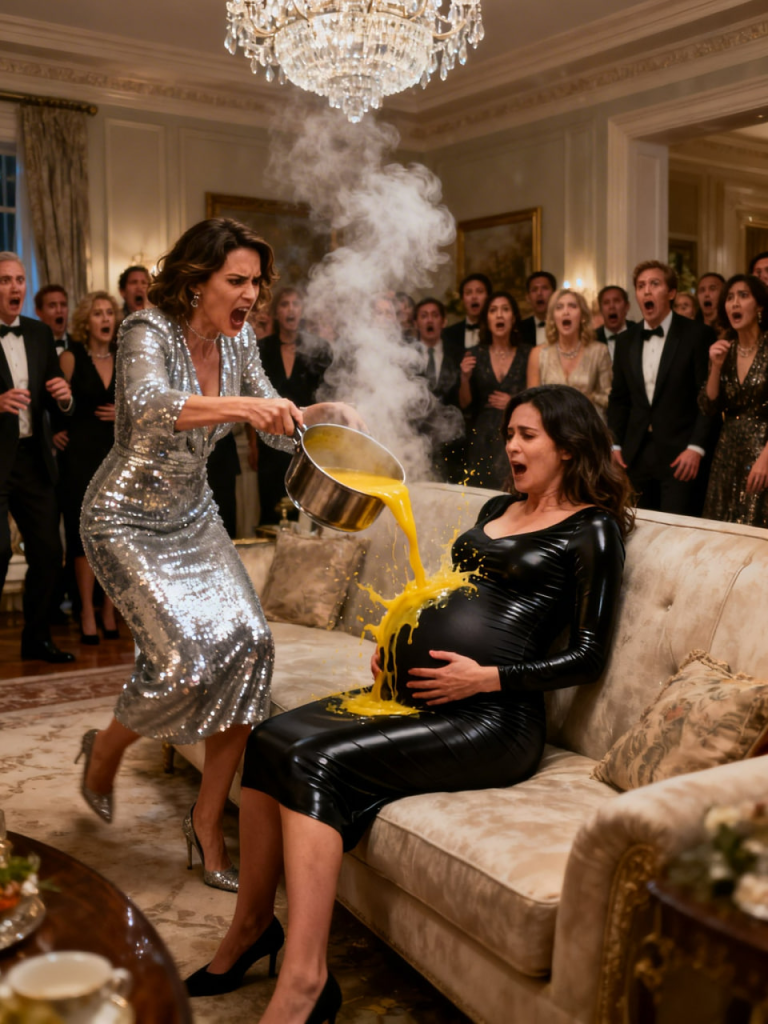
Boiling gravy poured over my forearm and down the front of my dress.
For a split second, my brain didn’t understand what was happening. It was just warmth, like a spill. And then the pain hit—sharp, immediate, like my skin had turned into a live wire.
I screamed.
The sound ripped out of me, raw and animal. My knees buckled. My hand flew to my belly instinctively, even as my arm flailed, trying to shake off the burning.
Jenna gasped theatrically. “Oh my God! Claire!”
My vision blurred. Pain detonated in my arm, my chest, my stomach where the gravy had splattered. I stumbled backward, desperate for distance from the heat, from her, from the stove.
Behind me was the doorway.
Behind the doorway was the staircase.
My heel caught the edge of the rug.
Time slowed in the way it only does when you’re about to get hurt and your body knows it.
My arms windmilled uselessly. My belly pulled me forward. I reached for the banister, but my burned arm wouldn’t cooperate.
And then I was falling.
I remember the sound more than anything—a thud, then another, my shoulder striking wood, my hip catching a step. The banister flashed past my face. The ceiling spun. Pain layered on pain until it became one big white roar.
I hit the bottom with a crack that seemed to echo through the house.
For a second, I couldn’t breathe.
Then the baby kicked hard—one jarring jab that made terror flood my chest.
“No,” I whispered, though I don’t know to whom. My body. My child. God.
Footsteps thundered above me. Voices spilled into the stairwell.
“Oh my—”
“Did she—?”
“Claire!”
And then, slicing through the chaos like a knife through cloth, came laughter.
Not everyone. Not a chorus.
But enough.
A snort. A chuckle. The kind of laugh people make when something goes wrong and they don’t know what to do with their discomfort, so they turn it into entertainment.
It was Uncle Rob, I think. It might’ve been Aunt Marlene. It might’ve been Jenna herself, because when I looked up, through the blur of tears, I saw her at the top of the stairs with her hand over her mouth, eyes wide—except her eyes weren’t scared.
They were bright.
Like this was the moment she’d been waiting for.
My mother pushed past someone and hurried down the stairs, her face pale. “Claire, don’t move! Don’t move!”
“I can’t—” My voice broke. The burn on my arm pulsed. My hip screamed. My belly felt tight, hard as stone.
Jenna rushed down behind her, still clutching the dish towel like a prop. “It was an accident,” she said quickly, loudly, as if the house itself needed to hear it. “She just… she startled me, and—”
I looked at her. Really looked.
And something inside me cracked open, not from the fall, not from the burn, but from the sound of that laughter.
I’d been the family mistake for so long that I’d started believing I deserved it. I’d built my life around minimizing myself so no one could trip over me. I’d apologized for existing. I’d tried to earn a place at the table by being easy, quiet, grateful.
And here I was—eight months pregnant, in pain, sprawled at the bottom of the stairs like discarded laundry—while they explained it away like a slapstick scene.
My breaking point didn’t feel dramatic. It felt clean.
It felt like a door locking.
“Call,” I croaked, “an ambulance.”
My mother fumbled for her phone. Jenna hovered, wringing her hands.
“I’m fine,” Jenna said, still performing, eyes darting toward the living room as if checking who was watching. “She’s fine. She’s just—Claire, you always overreact—”
My head snapped toward her so fast it made me dizzy.
“Shut up,” I whispered.
The word surprised me. It had a sharp edge. It wasn’t a plea. It was a command.
Jenna blinked, offended. “Excuse me?”
“I said shut up.” My voice rose, fueled by pain and something hotter. “Don’t talk. Don’t touch me. Don’t come near me.”
Silence fell, thick as gravy.
From the living room, people drifted closer, peeking around the corner like spectators. I saw phones in hands. I saw curiosity disguised as concern.
My mother pressed the phone to her ear, voice trembling as she spoke to 911.
I lay there, breathing shallow, and watched Jenna’s face rearrange itself—hurt, confused, victimized.
Because Jenna could dump boiling gravy on a pregnant woman, and in her mind, she would still somehow be the one wronged if that pregnant woman didn’t smile about it.
The paramedics arrived fast, their boots heavy on the steps. They asked questions, their voices calm in the way trained voices are calm. They checked my belly with a handheld monitor, listened for a heartbeat. My baby’s heartbeat filled the stairwell—rapid, steady, alive.
Relief hit me so hard I sobbed.
They wrapped my arm in cool, wet cloths. They put me on a stretcher. As they wheeled me through the living room, everyone made a path, faces arranged in sympathy.
I caught fragments.
“She’s always so clumsy.”
“Is she sure she didn’t slip?”
“You know Claire…”
Jenna trailed alongside, tears now sliding down her cheeks as if on cue. “Claire, I’m so sorry,” she said, loud enough for everyone to hear. “Please, tell them it was an accident.”
I turned my head toward her, pain making my vision swim.
“I’m going to tell them the truth,” I said.
The words landed like a dropped plate.
Jenna’s tears froze. My mother made a small strangled sound.
The paramedic asked, “Ma’am, do you feel safe at home?”
The question was routine. It was also a spotlight.
I stared at the ceiling as the stretcher rolled over the threshold. Outside, the October air slapped my damp skin. The porch light blinded me.
Safe at home.
I thought of the stairs. The laughter. Jenna’s bright eyes.
“No,” I said, and my voice didn’t shake. “I don’t.”
At the hospital, everything became fluorescent and fast.
They took me into triage, then immediately into labor and delivery because of how far along I was. Nurses peeled my dress away, clucking softly at the angry red patches on my stomach and chest. They ran cool saline over my burns. They strapped monitors around my belly.
A doctor pressed on my abdomen and asked if I felt tightening.
I did. It came in waves, hardening my belly like a fist.
“Any fluid?” she asked.
“No,” I whispered.
“Any bleeding?”
“No.”
“Okay,” she said, not comforting me, but anchoring me. “We’re going to watch you closely. The fall is the bigger concern, but the burns… we need to treat those too.”
They moved me to a room with a curtain. The monitors beeped. The baby’s heartbeat chattered like a nervous bird.
A nurse with kind eyes leaned close. “Do you know what happened?” she asked gently. “Did someone push you?”
I swallowed. My burned arm throbbed. My hip felt like it had been split with an axe.
I could hear Jenna’s voice in my head: Tell them it was an accident.
I could hear my mother’s voice: Don’t make it worse.
I could hear the laughter.
And then I heard my own voice, finally catching up to the woman I’d become.
“My sister spilled boiling gravy on me,” I said. “And I fell.”
The nurse’s face changed—not into shock, but into something harder. Recognition. Professional concern.
“Was it intentional?”
My throat tightened. Saying it out loud made it real in a way my mind wanted to resist.
“I… I think so,” I said. “She… bumped me. She tipped it.”
The nurse nodded once, as if she’d already decided something. “Okay,” she said softly. “I’m going to call our social worker and let the doctor know. And we’re going to call security if anyone shows up and you don’t want them here.”
I stared at her, stunned.
Someone believed me without making me prove I deserved belief.
It hit me almost as hard as the fall.
About an hour later, my phone buzzed. Marcus.
I answered with shaking fingers.
“Claire?” His voice was tight. Wind crackled in the background. “Your mom just called. She said you fell down the stairs. Are you—are you okay?”
I exhaled, and the breath turned into a sob. “I’m at the hospital,” I said. “The baby’s okay so far. I’m burned. I—Marcus, Jenna did it.”
There was a pause so long I thought the call dropped.
“What do you mean?” he said, carefully, as if he was walking toward the edge of something.
“She poured gravy on me,” I whispered. “Boiling. And I fell. And they laughed. And she’s saying it was an accident.”
I heard Marcus inhale, sharp.
“I’m coming,” he said, voice turning into steel. “I don’t care what job I’m on. I’m coming.”
“You’re three hours away,” I said automatically, still trying to manage everything even while broken.
“I’m coming,” he repeated. “Listen to me. Don’t let them in that room. Don’t sign anything. Don’t agree to anything. I’m on my way.”
When the call ended, I stared at the ceiling again.
I had married Marcus in a courthouse with two friends as witnesses. My family hadn’t come—not because they couldn’t, but because Jenna had decided it was “tacky” and my mother had agreed. Marcus and I had done it anyway. It was the first time I’d chosen myself over their approval.
Now, in a hospital bed with burn dressings and a baby monitor strapped to me, I realized I was about to do it again.
The social worker arrived just after midnight, a woman with a clipboard and a soft, tired voice. She asked me questions: my address, my support system, whether I had somewhere safe to go after discharge.
Then she asked, “Do you want to file a report?”
My pulse thudded. A report meant police. Police meant official. Official meant consequences.
And consequences in my family were always treated like betrayal.
I pictured Jenna at the top of the stairs, eyes bright. I pictured my baby’s heartbeat racing on the monitor.
“Yes,” I said.
The police officer who came to my room wasn’t unkind. He was middle-aged, with a notepad and the patient expression of someone who’d heard every version of “it was an accident.” He asked me to describe what happened, step by step.
I did.
I told him about the heat, the bump, the tip, the fall, the laughter.
When I finished, he asked, “Were there any witnesses?”
I almost laughed, but it came out as a broken sound.
“All of them,” I said. “My whole family.”
He nodded slowly. “Any cameras in the house?” he asked.
That question stopped me.
Jenna loved cameras. She loved capturing moments, posting them, curating them. There were always photos. Always videos.
“I think so,” I said. “She has a camera by the front door. And she… she has cameras inside sometimes. Like for the dog.”
“Okay,” he said, writing. “We’ll request any footage. Also—do you have any messages with your sister?”
My phone lay on the bedside table. I’d been ignoring it, but now I picked it up and saw the notifications I’d missed.
Jenna: Claire please answer. This is getting out of hand.
My mother: Don’t do this. Please.
A group text from Aunt Marlene: We’re all praying for you. Let’s just keep this private.
Private. That word again. The family’s favorite bandage.
My skin burned. My hip ached. The baby monitor beeped steadily.
I opened Jenna’s message thread. There were older texts too—months of her passive-aggressive check-ins, her little digs disguised as care.
At the top, a new message appeared.
Jenna: You know you startled me. You always do that dramatic thing. Please don’t ruin my life over a freak accident.
My fingers hovered over the screen, and then, without thinking too hard, I typed back.
Me: You bumped me. You tipped the gravy. I’m burned and I fell. The baby could’ve died.
Three dots appeared. Jenna was typing.
Jenna: Stop saying that. You fell because you can’t balance. Don’t make this my fault.
I stared at those words until my vision blurred.
The officer leaned slightly to see. “That’s helpful,” he said quietly. “Keep those.”
Helpful. Evidence.
In the morning, Marcus arrived with red eyes and a jaw clenched so tight it looked painful. He kissed my forehead, then my belly, then carefully inspected my bandaged arm like he wanted to memorize every injury.
He didn’t ask me if I was sure. He didn’t suggest smoothing it over. He didn’t say, “But she’s your sister.”
He just said, “Tell me what you need.”
What I needed was something I’d never let myself ask for: protection.
When Jenna showed up around noon, she didn’t come alone. My mother was with her, and my father trailed behind like a man who’d forgotten how to lead.
Jenna carried a bouquet of grocery-store flowers. She wore big sunglasses. She looked like someone staging regret.
Security stopped them at the desk because I’d already asked the nurse to block visitors unless I approved. The nurse came to my bedside and said, “Your family is here. Do you want to see them?”
Marcus’s hand covered mine. His thumb rubbed my knuckles once, steadying.
My stomach tightened—not with labor this time, but with the old fear of confrontation.
Then I pictured the laughter again.
“No,” I said. “Not Jenna.”
The nurse nodded without hesitation and went back out.
A minute later, my phone buzzed.
Mom: Please. She’s sorry. Just talk to her.
Jenna: This is insane. You’re making me look like a monster.
Dad: We can handle this as a family.
I read the messages, and something in me went quiet.
As a family. That phrase meant: as a unit that protected itself, not its members. It meant: close ranks, blame Claire, preserve Jenna.
Marcus watched my face. “You don’t have to answer,” he said.
I looked at him, then at the monitor showing my baby’s heartbeat.
“I’m going to,” I said.
I typed one message into the family group chat, the one my mother had refused to delete even after I’d left because she loved the illusion of togetherness.
Me: I’m filing a report. I don’t want Jenna near me. Do not come to the hospital again.
Silence followed for about thirty seconds.
Then the replies exploded.
Aunt Marlene: Claire, think about what you’re doing.
Uncle Rob: You’re really gonna do this? Over gravy?
Mom: Stop. Please stop.
Jenna: You always hated me. This is what you wanted.
There it was. The story they preferred: not that Jenna hurt me, but that I’d orchestrated it to punish her. Because in my family, Jenna couldn’t be the villain. So I had to be.
My hands shook, but my voice didn’t when I said to Marcus, “I’m done.”
The doctor kept me overnight for observation. The contractions slowed with medication, but my body stayed tense, like it didn’t trust the world anymore. The burns were partial thickness—painful, blistering, but not life-threatening if treated properly. The fall had bruised my hip badly, but there was no fracture.
Still, I flinched every time someone opened the door.
A nurse noticed and said gently, “You’ve been through trauma. It’s normal.”
Trauma. Another word that made my family uncomfortable.
When I was discharged, Marcus didn’t take me to our apartment.
He took me to his sister’s house.
Tanya lived across town in a small ranch with a fenced backyard and a couch that smelled like fabric softener. She hugged me carefully, avoiding my bandages, and said, “You’re safe here,” like it was a fact, not a favor.
That night, while Marcus showered, Tanya sat with me at the kitchen table and slid her laptop over.
“Marcus told me what happened,” she said. “I’m going to ask you something and you don’t have to answer if you’re not ready.”
I stared at the screen. It showed a paused video: a view of a front porch, slightly fisheye, like a doorbell camera.
“How did you get that?” I asked, voice rough.
Tanya’s mouth tightened. “My friend lives two houses down from your mom. She has a camera too—covers part of the sidewalk. She said she saw the ambulance and checked her footage. It doesn’t show inside, but it shows who left the house and when.”
My pulse quickened.
“What does it show?”
Tanya clicked play.
I watched the screen as paramedics rolled my stretcher out. Behind them, Jenna followed, crying dramatically, her hands fluttering.
Then, as soon as she crossed the porch line—out of view of the living room, out of reach of the audience—her face changed.
Her tears stopped like someone hit a switch.
She looked at the stretcher, then up at the camera’s general direction, and she smiled.
It wasn’t a big smile. It was quick. Private.
But it was unmistakable.
My stomach turned.
Tanya paused it. “My friend sent it to me. She said she’d send it to the police if you want.”
I stared at Jenna’s frozen face on the screen, that tiny satisfied curve of her mouth.
The laughter wasn’t an accident.
The spill wasn’t an accident.
This wasn’t a freak moment.
It was Jenna doing what she’d always done—pushing me until I broke, and then watching to see if anyone cared.
My breaking point had already happened at the bottom of the stairs.
But this—this was something else.
This was clarity.
“Yes,” I said, voice low. “Send it.”
The investigation moved faster than I expected.
A detective called me two days later. He said they’d requested Jenna’s doorbell footage and any internal camera footage from the house. Jenna claimed the cameras “weren’t working.” Funny how that happened.
But my mother’s neighbor had her own camera. Tanya’s friend had that porch clip. And Jenna—because Jenna couldn’t help herself—had posted photos from the reunion before everything went wrong.
One of the photos was in the kitchen. It showed the spread. It showed the stove. And there, near the edge of the counter, was the gravy boat—steam rising like a warning.
The detective said, “We also spoke to your relatives.”
I almost asked, And did they lie? But I already knew the answer.
“Some are calling it an accident,” he said carefully. “But their stories aren’t consistent. And your sister’s explanation doesn’t match your burns. The medical report indicates the liquid was extremely hot.”
Extremely hot. The kind of hot you get when something is boiling.
Jenna had boiled it.
She had boiled it, handed it to me, and tipped it.
When the detective asked if I wanted to press charges, my mother called again, crying so hard she could barely speak.
“This is tearing the family apart,” she sobbed.
I stared at the wall while she talked, my arm wrapped in gauze, my baby rolling gently inside me.
“No,” I said when she finally paused. “Jenna tore it apart.”
My mother inhaled like I’d slapped her.
“She’s your sister,” she whispered.
“And I’m your daughter,” I replied. “I was on those stairs. I was burned. And you let her stand there and say I was dramatic.”
Silence crackled on the line.
Then my mother did what she always did when confronted with something she couldn’t clean up.
She ended the call.
Jenna didn’t end the call.
She showed up at Tanya’s house.
It was a Thursday afternoon. Marcus was at work. Tanya was in the backyard with her kids. I was inside, sitting on the couch with my feet elevated, trying to breathe through the ache in my hip.
The doorbell rang.
Tanya’s dog barked. I looked at the camera feed on Tanya’s phone and felt my blood run cold.
Jenna stood on the porch, sunglasses on, lips pressed in a thin line. My mother stood behind her, arms crossed.
They hadn’t been invited. They didn’t have my address from me. Which meant someone had given it to them.
My hands started shaking.
Tanya came in, saw the screen, and swore under her breath. “Do you want me to tell them to leave?”
I swallowed. My heart hammered like it wanted out.
And then I heard the laughter again—like a ghost in my ear.
“I’ll handle it,” I said, and I surprised myself.
Tanya looked at me, worried. “Claire—”
“I’ll handle it,” I repeated, and this time my voice held.
She followed me anyway, staying close.
I opened the door only as far as the chain allowed.
Jenna’s face lit up like she’d won something. “There you are,” she said brightly. “We need to talk.”
“No,” I said.
My mother’s eyes narrowed. “Claire, don’t be childish.”
Childish. That word had been used on me like a leash my whole life.
“You can’t just shut us out,” Jenna added, her voice sharpening. “This is family.”
I held the door chain with my good hand. My burned arm throbbed, but it didn’t matter.
“You came to my house,” I said slowly, “after you burned me and I fell down the stairs.”
Jenna flinched like I’d lied. “It was an accident.”
“You smiled,” I said.
Her mouth opened, then closed.
My mother’s face tightened. “What are you talking about?”
“There’s footage,” I said. “Not from your house. From the neighbor. It shows Jenna smiling after the ambulance came.”
Jenna’s sunglasses hid her eyes, but her posture changed. The performance slipped.
“That doesn’t mean anything,” she snapped.
“It means everything,” I said, and my voice was calm in a way that felt unfamiliar. “You were happy.”
Jenna’s cheeks reddened. “You always twist things!”
I leaned forward slightly, letting her feel my presence without giving her access. “You don’t get to rewrite this,” I said. “Not anymore.”
My mother stepped closer, voice low and furious. “You’re ruining your sister’s life.”
I stared at her. My own mother. The woman who had watched me bleed and still chose Jenna.
“You were okay with her ruining mine,” I said quietly. “You were okay with her risking my baby’s life.”
My mother’s lips trembled. For a second, I saw something like doubt flicker in her eyes.
Then Jenna snapped, “Oh my God, stop with the baby guilt! The baby is fine!”
I felt something in my chest tighten—not fear this time, but anger so clean it felt like oxygen.
“Get off this porch,” I said.
Jenna laughed, a short ugly sound. “Or what?”
Tanya stepped forward, voice firm. “Or I call the police. Now. You’re trespassing.”
Jenna turned on Tanya like a spotlight shifting. “Who are you?”
“The person who’s actually protecting her,” Tanya said. “Unlike you.”
Jenna’s mouth twisted. My mother grabbed Jenna’s arm, as if realizing too late that this wasn’t going to play well.
“This isn’t over,” Jenna hissed at me.
“It is,” I said.
And I closed the door.
My knees trembled as the chain slid free and the lock clicked into place. Tanya touched my shoulder gently.
“You okay?” she asked.
I swallowed, then nodded.
Because for the first time, I believed it.
The charges became real a week later.
Assault. Reckless endangerment. A restraining order granted based on the incident and Jenna’s attempt to show up at my new address.
When the papers were served, Jenna called me from a blocked number, screaming so loud I had to hold the phone away from my ear.
“You think you’re so righteous!” she shrieked. “You think you can just destroy me and walk away!”
I waited until she ran out of breath.
“I’m not destroying you,” I said. “I’m letting you face what you did.”
She spat my name like it was poison. “You always wanted everyone to hate me.”
I almost laughed, but this time it wasn’t broken. It was bitter.
“No,” I said. “I wanted you to stop.”
She hung up.
My mother didn’t call. My father sent one text: I don’t know what to do.
I stared at it for a long time before I replied.
Me: You can start by telling the truth.
He never answered.
As my due date approached, my body carried more than a baby.
It carried the constant buzz of adrenaline, the flinch reflex, the nights where I woke up sweating because I dreamed of stairs. I started therapy because Tanya insisted and Marcus backed her up. The therapist didn’t tell me to forgive. She didn’t tell me to “see Jenna’s side.”
She told me something I didn’t know I needed.
“What happened to you was abuse,” she said. “And you’re allowed to be angry.”
Allowed.
I practiced saying no in that room. I practiced not apologizing when I took up space. I practiced believing my own memory.
And then, at thirty-six weeks, my water broke at two in the morning.
Marcus was already awake because he’d been waking up every hour like he was waiting for a disaster. He bolted upright when I said, “It’s time,” and then immediately tripped over his own shoes.
I laughed—actually laughed—through the pain of my first contraction.
“Don’t you dare fall,” I told him, half crying, half laughing.
We went to the hospital under a sky so black it looked painted. Tanya met us there. She held my hand through contractions and told me I was strong, and I believed her because she wasn’t saying it to perform. She was saying it like she knew it.
The labor was long and brutal. My burned arm had healed enough that the bandages were gone, but the skin was still tender, shiny in places. My hip ached with every shift. I screamed, I cried, I swore I couldn’t do it.
Marcus kept saying, “You can,” like a mantra.
And then, after hours that felt like a lifetime, my baby arrived—red-faced, furious, perfect.
A girl.
They placed her on my chest, warm and slippery and alive, and I sobbed so hard I could barely breathe.
Marcus cried too, his face crumpling in a way I’d never seen.
“Hi,” I whispered to her, voice shaking. “Hi, baby. I’m here.”
In the haze after delivery, while nurses bustled and Tanya snapped pictures, my phone buzzed.
A message request.
Jenna.
I stared at the screen, heart thudding, and then I saw the name beneath it.
My mother.
Mom: I heard she’s here. Can I please come. Just me.
I lay there, my daughter sleeping against my skin. The room smelled like antiseptic and baby shampoo. My body felt wrecked and holy.
Marcus watched me read the message. “You don’t have to,” he said softly.
I looked at my daughter’s tiny fist curled under her chin.
I thought of the staircase.
I thought of laughter.
I thought of my mother’s dish towel, her trembling hands, her phone to her ear while Jenna performed innocence.
And then I thought of the word that had changed everything for me.
Allowed.
I was allowed to protect my peace.
I typed back.
Me: No. Not today. I’ll let you know when I’m ready.
My mother responded almost immediately.
Mom: Please don’t keep her from me. Please.
Her.
Not me. Not the daughter she’d failed.
The baby.
I felt something settle in my bones.
Me: If you want to know her, you’ll have to respect me.
No reply came.
Hours later, a nurse told us security had turned someone away at the front desk—a woman wearing sunglasses, demanding to be let in because she was “the aunt.”
The restraining order worked.
For the first time in my life, the system held a boundary my family never would.
In the months that followed, Jenna took a plea deal. No jail time, but probation, mandated counseling, community service, and a record that would follow her like a shadow. It wasn’t the dramatic downfall people imagine when they hear “nightmare of consequences.” It was quieter than that.
But it was real.
It meant she couldn’t pretend nothing happened.
It meant she couldn’t twist the story without someone being able to say, “Actually, the court disagreed.”
My family split like a cracked plate. Some relatives stopped speaking to me entirely. Some sent vague holiday cards with no return address. My father came to Tanya’s once, standing on the porch like he didn’t know if he was allowed inside, and said, “I’m sorry,” so quietly I almost missed it.
I didn’t forgive him on the spot. I didn’t offer him comfort. I just nodded and said, “Okay,” because forgiveness wasn’t a gift I handed out to make other people feel better.
My mother didn’t come.
Not for the birth. Not for the first month. Not for the first time my daughter smiled. She stayed wrapped around Jenna like ivy, clinging to the child who punished her less for choosing wrong.
But something unexpected happened: the absence didn’t kill me.
It healed me.
Because when you stop waiting for someone to love you the right way, you finally have room to love yourself.
Marcus and I moved into a new place—small, sunlit, stairs-free. Tanya lived ten minutes away. Our friends became our family in the way people always say but rarely mean: casseroles on the porch, texts at midnight, someone to hold the baby so you could shower without feeling like the world would collapse.
One evening, months after the reunion, I stood in our kitchen stirring gravy—because life has a twisted sense of humor—and my daughter sat in her bouncy seat, watching me with solemn baby eyes.
The gravy bubbled gently. Steam rose. My arm, the one that had burned, ached with old memory.
I turned the heat down, poured carefully into a bowl, and carried it to the table like it was something sacred.
Marcus watched me, understanding without words.
“You okay?” he asked.
I looked at my daughter, at her tiny hands, her soft cheeks, her whole future stretched out like a clean page.
“I am,” I said.
And I meant it.
Because the breaking point I’d hit at the bottom of my sister’s stairs hadn’t destroyed me.
It had finally, finally set me free.
Leave a Reply