My Sister, America’s Sweetheart, Split My Lip at Her Own Gala—One Call Exposed the Secrets She Built Her Fame On
The bathroom light at the Riverstone Hotel was the kind that made every flaw look like a confession.
It didn’t flatter. It didn’t soften. It didn’t forgive.
It just told the truth in sharp white clarity, the kind you couldn’t blink away. I leaned over the sink and watched my own blood drip into porcelain like it belonged to someone else. My lip was split clean enough that I could feel the air on the inside of it. When I touched my mouth, my fingertips came back red. I opened wider and saw blood smeared across my teeth, bright against white like a warning label.
I should have been in the ballroom.
I should have been at the round table nearest the stage, poised with a practiced smile, ready to clap at the right times, ready to look like I belonged in a room full of donors and producers and polished people with professional laughter. I should have been watching my sister accept her award.
Instead, I was in a bathroom stall-sized sanctuary, bracing my hands on cold marble, swallowing copper and shame.
Outside that door, somewhere down the hall, my sister’s name was being lifted like a toast. America’s sweetheart. The darling who always thanked the nurses, always hugged the veterans, always cried at the right parts of her own speeches.
Cami Vale.
Camille Valentina Harper to our mother, and just “Cami” to the world.
And to me—tonight—she was a fist and a handful of my hair and a sound in my ear that I’d never forget.
“Get out,” she’d hissed, right after she hit me, right after seventy people went still like mannequins, right after my mother’s lips curved into a pleased little crescent and her eyes did not soften even once.
“Get out before you ruin this.”
As if I could ruin it.
As if I hadn’t spent years building it.
I cupped water in my hands and rinsed my mouth. More blood swirled down the drain, and the sound was too quiet for what it meant. I held a paper towel to my lip and stared at myself.
My eye was already swelling on one side. My hair was half unpinned, one earring missing. Mascara shadowed under my eyes, making me look like the kind of woman strangers passed on sidewalks without meeting her gaze.
And in my reflection, behind the bruising and shock, there it was again: that familiar question I’d been swallowing my whole life.
How much more?
How much more of me was I going to hand over just to keep her shining?
My phone vibrated in my clutch.
A text from our mother, Dolores Harper:
DO NOT COME BACK IN. FIX YOUR FACE. YOU’RE EMBARRASSING.
I read it twice. Then a third time, just to confirm that my own mother had written it while her older daughter was bleeding in a hotel bathroom after being assaulted by her younger daughter.
I laughed once—one short, stunned sound that had no humor in it at all.
That laugh turned into a tight swallow.
Because the truth was, I’d always known who my mother was.
I’d just kept hoping she might become someone else.
The Riverstone Hotel’s bathroom smelled like expensive soap and panic. The paper towels were soft and useless. I pressed again against the split in my lip and felt a pulse of pain that traveled into my jaw.
I should have called 911.
I should have called a friend.
I should have called literally anyone.
But my thumb hovered over one contact like it had its own mind.
Reese Caldwell.
He’d been a name in my phone for years, a quiet presence in the margins of my life—like a locked door you kept a key for but never used. Dad had introduced us before he died, back when I was still young enough to think “family lawyer” sounded like something people in movies had, not something our family would ever need.
Reese had handled the estate. He’d read my father’s will with a steady voice while my mother dabbed imaginary tears and Cami stared at the ceiling like she was bored of grief already.
Afterward, Reese had found me alone by the elevators and said, quietly, “If you ever need help, Nora… call me. Not for paperwork. For you.”
I’d almost cried then. Not because of his words, exactly, but because someone had seen me.
I hadn’t called him. Not once.
Until tonight.
My thumb hit the name before my courage could evaporate.
The dial tone hummed in my ear like a wire tightening.
He answered on the second ring. “Nora?”
His voice was calm, like he’d been expecting me for years.
I closed my eyes, leaning my forehead against the cool mirror. “It happened,” I said.
A pause. I heard him inhale, controlled. “Are you safe?”
“I’m… in the women’s restroom off the ballroom corridor. Riverstone Hotel.” I swallowed. My lip stung. “She hit me. In front of everyone.”
Another beat. “Do you need an ambulance?”
“I need… I need it to stop,” I whispered, and the words surprised me with their simplicity.
Reese’s voice sharpened—not with anger, but with clarity. “Nora, listen carefully. Are you willing to proceed?”
Proceed.
That word was a doorway. That word was a line.
Because we both knew this wasn’t only about a split lip.
This was about the last ten years. The lies. The accounting. The signatures. The quiet transfers. The fake invoices. The charity galas staged like film sets while the real money slid sideways into accounts that had nothing to do with helping anyone.
This was about how Cami’s foundation had become her costume, and I’d been the seamstress stitching it together.
Reese had once asked me, gently, if I understood what my name on those documents meant.
I’d said yes.
He’d said, “Then you understand that silence has a cost.”
I’d kept paying it anyway.
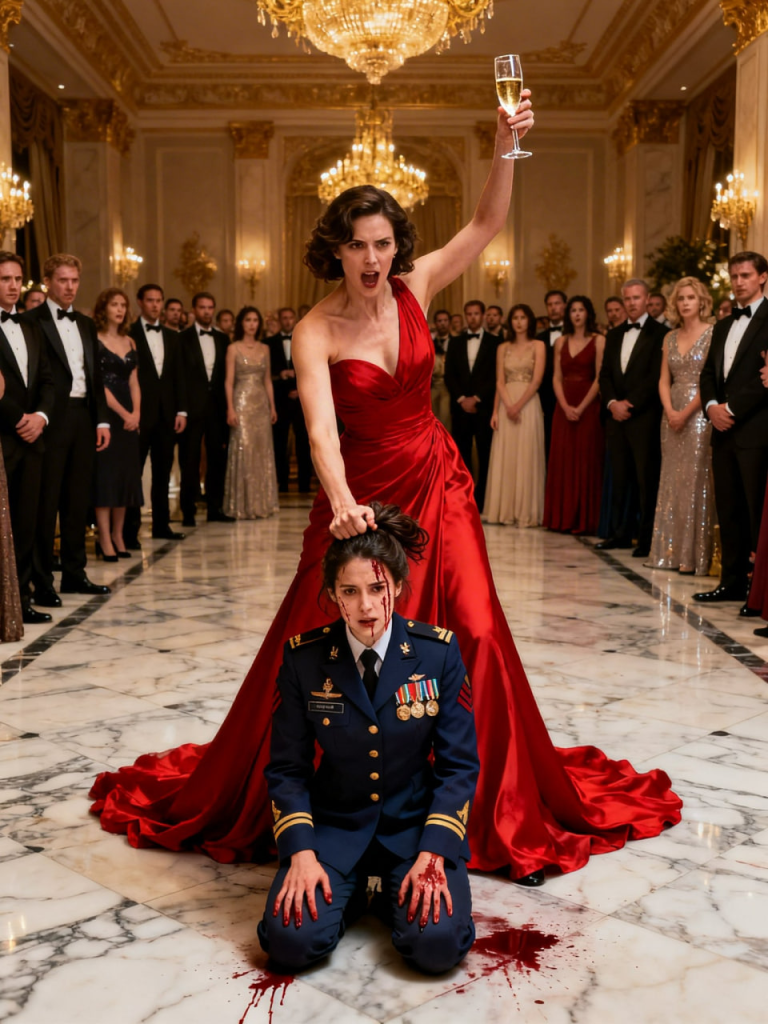
Tonight, my mother smiled while her golden child dragged me out by my hair.
Tonight, the cost became impossible.
“Yes,” I said. My voice shook, but it didn’t break. “I’m willing.”
Reese’s tone turned professional. “Good. Don’t leave. I’m already in the building.”
My stomach dropped. “What?”
“The Riverstone hosts this gala every year,” he said. “I’m counsel for one of the sponsors. I saw your name on the guest list. I had a feeling you might be here.”
My hand tightened around the phone. “So you were out there.”
“Yes.” His voice softened. “And no, I didn’t see it happen. But I will handle it now.”
I stared at myself again, searching my own eyes for the old habit—minimize, excuse, smooth it over.
Instead, I found something colder and steadier.
“Do it,” I said.
Reese exhaled once, like a man stepping into a storm he’d prepared for. “Then we activate the package.”
The package.
A year ago, I’d met him in his office after an audit scare—one of Cami’s donors had asked too many questions. I’d been terrified, but Cami had kissed my forehead like I was a child and said, “Relax, Nor. You worry too much. That’s why I keep you. You’re useful.”
Useful.
Like a tool.
Reese had listened to me describe “small irregularities” while my hands trembled in my lap.
Then he’d slid a plain manila envelope across his desk and said, “If you ever reach a point where you cannot do this anymore, you call me and say the word riverstone. I’ll know you’re done. I’ll know you want out. And I’ll know you want truth.”
I’d taken the envelope like it was a bomb. Inside were instructions—legal and practical. The list of agencies. The emergency motion ready to file if I became the target. The contacts. The steps.
A plan for the moment when my life finally demanded courage.
I’d kept it in a safe deposit box at a bank across town, untouched.
But Reese had copies of everything that mattered.
“Okay,” I whispered into the phone. “Riverstone.”
“I heard you,” Reese said. “Stay put. Keep the phone on. If anyone comes in, do not engage. And Nora?”
“Yeah?”
“You didn’t ruin anything,” he said. “They did.”
The line clicked as he ended the call.
My hands were shaking so hard I had to sit on the closed toilet lid to steady myself. I pressed the towel to my lip again. My ears rang.
Outside, the muffled sound of applause thudded through the wall like a heartbeat.
They were probably introducing her now.
Cami in her white gown—always white, like innocence was a brand color—stepping onto a stage with gold lights and perfect hair.
The room would rise for her. They always did.
They didn’t rise for me.
I thought of the moment it happened.
The punch itself had been almost quiet, a short brutal impact that flashed white across my vision. What I remembered most wasn’t the pain—it was the shock of skin against skin and the way people froze like their bodies didn’t know what to do with the truth.
We’d been near the stage, behind a pillar where the photographers couldn’t easily see, waiting for her cue. I’d handed her the small card with the corrected numbers—because she’d insisted on adding a line about “two million meals served” even though the actual number was far less, and I couldn’t let her lie that blatantly with press in the room.
“It’s one point three,” I’d said quietly. “The rest aren’t verified. You can say ‘over a million.’ That’s honest.”
Cami’s eyes had narrowed, glittering with something sharp. “You’re always ruining things with your details.”
“They’re not details,” I’d said. “They’re facts.”
Her smile had still been on her face, the public one, the one that made strangers want to trust her. But up close, her teeth clenched like she wanted to bite.
“You don’t get to correct me,” she whispered. “Not tonight.”
“I’m not correcting you,” I’d insisted. “I’m protecting you.”
That was when she hit me. Not a slap. A punch.
And then, because violence wasn’t enough—because she needed dominance—she grabbed my hair and yanked me sideways, dragging me out from behind the pillar like a dog being pulled from a room.
My heels had scraped. Someone gasped. Someone laughed nervously like it was a joke.
My mother stood two feet away, a champagne flute in her hand, watching like she was admiring a performance.
When Cami dragged me toward the corridor, I’d looked at Mom. I’d looked for even a flicker of concern.
Dolores Harper smiled.
Not a nervous smile.
Not a forced smile.
A satisfied one.
Like she’d finally seen her favorite daughter put the other one in her place.
That image lodged into me deeper than the fist.
Because I could survive Cami’s cruelty.
I’d been doing it since we were kids.
What I couldn’t survive anymore was my mother’s approval of it.
I dabbed my lip again, and my mind slid backward, uninvited, to the beginning.
Cami and I hadn’t always been enemies.
When she was little—before the cameras, before the stylists, before she learned how to weaponize sweetness—she’d crawl into my bed at night during thunderstorms and whisper, “Tell me a story, Nora.”
I would. I’d make up worlds with brave girls and secret doors. She’d fall asleep clutching my sleeve.
Then, somewhere around eleven, she discovered she could sing, and Mom discovered she could sell it.
Dolores wasn’t always cruel, not in obvious ways. She was charming. People loved her. She could turn on warmth like sunlight.
But warmth, I learned, could be selective.
It could be a spotlight.
And if you weren’t under it, you were in the dark.
When Cami got her first audition, Mom took her out for ice cream after and didn’t ask how my school day had been. When Cami got her first role in a commercial, Mom taped it on the fridge and never taped my report card. When Cami got her first magazine feature, Mom clipped it and framed it. When I got accepted into a university on scholarship, Mom said, “That’s nice,” and asked if I could help Cami rehearse.
Dad tried, at first. He’d ruffle my hair and say, “Nora’s smart. Nora’s steady. Nora will be just fine.”
He didn’t realize the damage of that sentence.
Because “fine” became my cage.
Cami became the dream.
Mom became its keeper.
And I became the scaffolding holding it up.
After Dad died, the scaffolding stopped being optional.
Cami was sixteen when the first scandal almost happened—she’d been caught sneaking out with an older boy, drunk, and someone had photos. Mom had screamed at me for two hours because I “wasn’t watching her enough.”
“I’m not her parent,” I’d cried.
“No,” Mom said, her eyes cold. “You’re not. You’re her sister. That’s worse. You owe her loyalty.”
Loyalty. Another word like a chain.
Cami went on to star in a teen drama, then a blockbuster, then a string of roles that made her face familiar in every grocery store checkout line.
America’s sweetheart.
And behind her, invisible, I handled the emails, the bookings, the scheduling, the apologies to assistants she reduced to tears, the hush money for a makeup artist she shoved, the contracts, the clauses, the “donations” to causes she’d never visited.
When she started the Hart Haven Foundation, Mom pitched it like salvation.
“It will show who Cami really is,” Mom said, her eyes bright. “The world will love her even more.”
The world did.
They saw Cami holding babies, hugging grandmothers, serving soup, smiling beside homeless shelters.
They didn’t see the rented props, the curated photo ops, the fact that the “soup kitchen” shifts were twenty minutes for cameras and then a quick exit through the back.
They didn’t see me, after the cameras left, sitting with the actual volunteers, writing checks to cover supplies because Cami’s “foundation budget” was being drained into “consulting fees” that were really payments to a shell company Mom controlled.
When I questioned it, Mom would say, “You don’t understand business.”
When I pressed, Cami would pout and say, “Why are you jealous of me? I thought you loved me.”
So I learned to swallow questions.
I learned to sign things.
I learned to keep the machine running.
But a machine that runs on lies eventually crushes the hands that feed it.
Tonight, it finally crushed my face in front of seventy people.
And the worst part wasn’t even the humiliation.
It was the sudden clarity.
None of them stepped in because they didn’t see me as a person.
They saw me as part of Cami’s background.
Like the flowers, like the lighting, like the staff.
Disposable.
A knock sounded on the bathroom door.
My whole body went rigid.
“Nora?” a woman’s voice called softly. “Are you in there?”
I recognized it. Willa, Cami’s assistant—one of the few people who ever looked at me with something like sympathy.
I didn’t answer. My throat tightened.
“Nora,” Willa said again, lower. “Security’s asking questions. Reese Caldwell is here. He asked me to find you.”
My breath hitched.
Reese was moving fast.
I stood, wiping my mouth, trying to smooth my hair with trembling fingers.
The door opened slowly, and Willa stepped in. Her eyes widened when she saw my face.
“Oh my God,” she whispered.
“It’s fine,” I said automatically.
Willa’s expression tightened. “It’s not.”
Behind her, two hotel security staff waited in the corridor, professional, grim. And beside them stood a man in a dark suit, silver hair, sharp gaze—Reese.
He took one look at me and his jaw flexed.
“Nora,” he said quietly, stepping closer. “I’m sorry.”
“Don’t be,” I managed. “Just… do what you said you’d do.”
Reese nodded once. He held out a small envelope—already opened. “You’re sure?”
I looked past him toward the ballroom. Through the crack of the double doors, I heard a swell of applause.
They were on their feet for her now.
My lip pulsed. My scalp ached where hair had been yanked.
I remembered my mother’s smile.
“I’m sure,” I said.
Reese turned to the security staff. “We need medical assistance immediately. And I need preservation of all security footage from the ballroom corridor and the backstage area. Now.”
One of the guards nodded and spoke into his radio.
Willa hovered beside me like she wasn’t sure whether to hug me or stay out of it. She whispered, “Cami is—she’s on stage. She doesn’t know—”
“She will,” Reese said.
He guided me down the corridor, away from the bathroom, toward a smaller conference room near the hotel offices. The carpet muffled our steps, but my heart thudded loud enough to feel like it could be heard.
As we walked, people glanced at me and then away quickly, like my bruised face was contagious.
Some recognized me. Most didn’t.
To them, I was just a woman in a black dress with blood on her mouth.
To me, I was a woman finally walking out of the dark.
Inside the conference room, Reese closed the door.
“First,” he said, “we document injuries. Then we file a report. Then we handle the rest.”
“The rest,” I echoed, almost numb.
Reese set a thick binder on the table. It looked heavy enough to break someone’s foot.
“I’ve already contacted the board chair of the Hart Haven Foundation,” he said. “He’s here tonight. So is the sponsor compliance team. So is a representative from the state attorney general’s office—pure coincidence, but useful.”
My stomach twisted. “How did you—”
“Because I’ve been waiting for this,” Reese said simply. “You’re not the first person to get hurt by a ‘sweetheart.’ You’re just the one with receipts.”
Receipts.
The word made my throat tighten.
I’d kept them. Quietly, obsessively, like some part of me always knew I’d need proof to escape my own family.
After the audit scare last year, I’d started saving copies of everything: invoices, wire transfers, emails where Mom instructed me to “reclassify” expenses, messages where Cami demanded donations be routed “through the Harper Consulting account,” contracts with suspicious vendors.
At the time, I’d told myself it was insurance. Protection.
But maybe it had been hope.
Hope that one day, I’d choose myself.
The sound of the ballroom erupted again—cheers, laughter.
Reese opened the binder. Inside were copies of documents I recognized. My handwriting on some. My signatures on others.
Shame rose in my chest like bile.
“I signed them,” I whispered.
Reese looked at me sharply. “Under coercion and manipulation. And you kept evidence. That matters.”
“Does it?” I asked, bitter.
“It does,” he said. “Because your sister and your mother have been careful. They built their empire on the assumption that you would never turn.”
I stared at the documents. “I didn’t think I’d ever have the nerve.”
Reese’s gaze softened. “Nora, you already had the nerve. You just didn’t have the permission. Now you’re giving it to yourself.”
A paramedic arrived, checking my lip and eye. As she worked, she asked gentle questions, and Reese took notes.
“I want to press charges,” I heard myself say.
The paramedic paused, meeting my gaze. “Okay. We can call police to take a statement.”
Reese nodded as if he’d expected it.
My phone buzzed again. Another text from Mom:
WHERE ARE YOU? CAMI IS ABOUT TO THANK YOU. DO NOT MAKE THIS ABOUT YOU.
My laugh came out raw.
“She’s going to thank me,” I muttered, holding the phone out to Reese like it was evidence of insanity.
Reese glanced at it. “Perfect.”
“What do you mean?”
He looked up. “It means she’s about to paint you as loyal family on stage. That’s useful. Because when the truth hits, it will hit harder.”
My stomach flipped.
I didn’t want revenge.
Not exactly.
I wanted relief.
I wanted the weight off my ribs.
I wanted to breathe in a world where my mother’s love wasn’t a prize and my sister’s fame wasn’t a god.
Still, part of me wanted something darker too.
Not violence.
Justice.
Consequences.
A world where a pretty smile didn’t erase a fist.
Through the wall, Cami’s voice floated faintly—amplified, smooth, bright as honey.
“…and I have to thank my incredible team,” she was saying. “They make the impossible possible…”
A fresh wave of applause.
I pictured her on stage, hand to heart, eyes shining with practiced sincerity.
I knew her tells. I knew how she made her voice quiver on cue.
“She’s going to say my name,” I whispered.
Reese checked his watch. “Good. Because in about sixty seconds, the room is going to change.”
“What are you doing?” I asked.
Reese picked up his phone and typed quickly. “I’m notifying the hotel to pause the program. I’m notifying the board chair. I’m notifying the sponsor reps. And I’m notifying law enforcement who already have preliminary interest in these documents.”
“How can it be that fast?” I asked, almost incredulous.
Reese’s expression was flat, unwavering. “Because people with power move quickly when their own liability is at stake.”
The truth of that landed like ice.
For years, I’d begged for small kindnesses.
The world had ignored me.
Now, because I had paper and proof, the world would sprint.
It was a sick kind of validation.
But I would take it.
A knock came at the conference room door.
A uniformed police officer stepped in, followed by a man in a tuxedo whose face I recognized: Martin Sloane, the chairman of the Hart Haven Foundation board.
His eyes went straight to my bruised face, and something like horror flickered.
“Oh,” he said, voice catching. “Oh my God.”
“Yes,” Reese said, standing. “Thank you for coming, Martin.”
Martin’s gaze darted. “I—Reese, what is going on? I got your message about… irregularities.”
Reese gestured to the binder. “Irregularities, assault, fraud. Take your pick.”
Martin swallowed hard, stepping closer. “Nora?”
I met his eyes. “Hi.”
He looked like he wanted to say sorry but didn’t know if he had the right. “We’re… we’re about to give her a standing ovation.”
“Yeah,” I said. “I heard.”
Martin stared at the binder, then at Reese. “If any of this is true—”
“It is,” Reese said. “And you’re about to find out in front of seventy people.”
Martin’s face drained.
The police officer cleared his throat. “Ma’am, I’m here to take a statement regarding an assault. Are you able to speak?”
I nodded.
My voice shook as I described what happened. I kept it factual. Punch. Hair. Dragged out. Mother smiled. No one intervened.
The officer wrote steadily, expression controlled, but his eyes hardened when I mentioned the mother’s reaction.
When I finished, Reese placed a pen in my hand. “Sign here.”
I signed.
A simple act.
A signature that, for once, wasn’t for them.
It was for me.
Then Reese said, “Now we go back.”
My pulse spiked. “Back where?”
“The ballroom,” he said.
I stared at him. “I can’t walk in there like this.”
Reese’s gaze didn’t waver. “Yes, you can. But you won’t walk in alone.”
Willa handed me an ice pack, her eyes shining with a mix of fear and fierce satisfaction. “I’ll come too,” she whispered.
I hadn’t realized she was choosing a side.
Maybe she was just choosing decency.
We moved down the corridor toward the ballroom doors. Every step felt like walking toward a cliff.
Inside, the applause rose again, roaring.
“…and especially my sister Nora,” Cami’s voice carried, bright and sweet. “The most loyal person I know. She’s always been my rock…”
My stomach clenched hard enough to hurt.
The doors opened.
The room was a sea of glittering faces—people in gowns and suits, champagne glasses raised, eyes turned toward the stage.
Cami stood under gold lights, smiling like she’d never thrown a punch in her life. Our mother sat at a front table, beaming like she’d been crowned too.
The moment I stepped in, a ripple went through the crowd.
Heads turned.
Someone gasped.
Cami’s smile faltered for half a second when she saw my face. It was tiny, almost invisible. But I knew her. I knew the crack.
Her eyes widened, then narrowed, then she laughed lightly into the microphone like it was all part of the show.
“Oh!” she said, voice bright. “There she is! Nora! Come up here—”
Reese stepped forward before I could move. He didn’t look like he belonged on a stage at a charity gala, but somehow he owned the room anyway.
He reached the front, turned slightly toward the stage, and lifted a hand.
“Excuse me,” Reese said, his voice carrying without a microphone. “This program needs to pause.”
The room froze.
Cami blinked, still smiling, trying to maintain control. “Reese—what is this? Is this some sponsor thing? We can talk after—”
“No,” Reese said. “We talk now.”
Martin Sloane stood from his table, face pale, and took a step forward.
Dolores Harper’s smile wavered for the first time.
“What is happening?” Mom demanded, her voice slicing through the silence.
Reese looked directly at the stage, then at the crowd.
“My name is Reese Caldwell,” he said. “I am counsel representing a sponsor of this event and—more importantly tonight—counsel for Nora Harper.”
Whispers burst like sparks.
Cami’s grip tightened on the award in her hands, knuckles whitening.
“Nora?” she said, laugh still forced. “What are you doing? You look—Jesus, did you fall? Did you—”
I stared up at her.
She was pretending.
In front of everyone.
My lip throbbed in time with my heartbeat.
I took a breath and stepped forward enough to be seen clearly by the room.
I didn’t need a microphone. The sight of blood on my teeth did the work.
“I didn’t fall,” I said.
The room went dead quiet.
Cami’s smile snapped, just a fraction. “Nora, don’t—”
“You hit me,” I said, and my voice steadied with every word. “You punched me in the face and dragged me by my hair.”
A collective gasp rolled through the ballroom, loud as a wave.
Cami’s face flashed—anger, panic, calculation.
Then she did what she always did.
She turned it into theater.
“Oh my God,” she said, hand flying to her mouth in perfect shock. “Nora—what are you talking about? Are you okay? Did you—did someone attack you?”
She looked at the crowd, eyes wide, inviting them to agree with her version of reality.
For a heartbeat, I felt the old fear—the fear that people would choose her story because it was prettier.
But Reese stepped forward again.
“The hotel has security footage,” he said calmly. “And Nora has filed a police report.”
At the word police, the room crackled.
Two officers appeared near the side entrance. They weren’t dramatic. They were simply present, a quiet authority that made the truth feel heavier.
Cami’s eyes darted, panic flickering.
My mother stood up abruptly, her chair scraping.
“This is ridiculous,” Dolores snapped. “Nora is emotional. She’s always been unstable. She’s trying to sabotage her sister because she can’t stand—”
“Stop,” I said.
The word came out low and sharp, and it startled even me.
Dolores blinked, as if she’d forgotten I could speak.
Reese turned slightly to face the crowd again. “There’s more,” he said.
Martin Sloane swallowed visibly. “Reese—”
“There’s more,” Reese repeated. “Because Nora’s injuries tonight are not an isolated incident. They are part of a broader pattern of coercion, misuse of funds, and misrepresentation tied to the Hart Haven Foundation.”
The room erupted into whispers again—shocked, hungry whispers.
Cami’s face drained. “That’s insane.”
Reese opened the binder and lifted a packet of documents like a weapon made of paper.
“These are internal records,” he said. “Invoices, wire transfers, communications. They indicate that donor funds were routed into accounts controlled by Dolores Harper and used for personal expenses.”
A low, stunned murmur rippled.
Dolores’s mouth opened, but no sound came out.
Cami’s hands shook around the award. “You can’t do this,” she hissed, the microphone catching the edge of her real voice before she could soften it.
Reese didn’t flinch. “We already have.”
He turned toward Martin. “As of this moment, Martin Sloane, as board chair, has been informed. Sponsor compliance has been informed. And law enforcement has been informed.”
Martin’s voice came out strained. “The board will convene immediately. Camille, you need to step down from your role pending investigation.”
Cami stared at him like he’d slapped her. “You’re kidding.”
Martin looked like he might vomit. “I’m not.”
Cami’s eyes snapped to me then, pure venom.
“You did this,” she whispered, not into the microphone but loud enough for the front tables to hear.
I met her gaze, blood dried at the corner of my mouth.
“No,” I said. “You did.”
For a moment, the room was suspended between stories.
The pretty one—the sweetheart, the charity, the bright stage.
And the ugly one—the bruises, the paperwork, the truth.
People shifted in their seats, discomfort twisting their faces.
Then something unexpected happened.
A woman stood up at a table near the aisle—an older woman in a navy dress with a silver necklace. I recognized her vaguely: a donor, maybe, or a local leader.
“I saw it,” she said, voice trembling but loud. “I saw you grab her hair.”
Silence hit again.
Another person stood. A man in a gray suit. “I did too,” he said. “And… I’m ashamed I didn’t step in.”
Then Willa, beside me, lifted her chin. “She’s been treated like this for years,” she said, voice shaking with anger. “Not just tonight. I’ve seen it. Staff have seen it.”
Cami looked around like a hunted animal, her façade cracking in real time.
Dolores’s voice rose, shrill. “You ungrateful—Nora, after everything we’ve done for you—”
A laugh broke out somewhere. Not a cruel laugh—a disbelieving one. The kind that comes when someone’s manipulation finally sounds absurd in public.
Cami stepped back from the microphone, eyes wild. “Mom—fix this,” she whispered.
Dolores reached for her, frantic now. “Cami, baby—”
But the room was already shifting away from them, like a tide turning.
Reese moved toward the officers, speaking quietly. Martin gestured urgently to hotel staff. Sponsor representatives gathered, their faces tight, phones already out.
The gala wasn’t a celebration anymore.
It was a collapse.
Cami tried one last time, voice sweet again, desperate. “Everyone, please—this is a misunderstanding. My sister is… she’s going through something. We’re a family, we can handle this privately—”
“No,” I said.
I didn’t shout. I didn’t cry.
I just said it with a steadiness that felt like someone else’s voice finally living in my body.
“We’re not handling it privately anymore.”
Cami stared at me, hatred and fear battling across her face.
Dolores’s eyes burned into mine. “You’re dead to me,” she hissed.
There it was.
The sentence she’d always been holding behind her smiles.
I felt something inside me unclench.
The truth was, I’d been dead to her for years.
I just hadn’t admitted it.
Police approached the stage. One spoke to Cami quietly. She shook her head violently, then pointed at me, mouth moving in furious protest.
The microphone caught a fragment: “—she’s lying—”
But the room didn’t lean toward her like it used to.
They leaned away.
Because blood is harder to edit than gossip.
Because proof is louder than charm.
Because once a mask cracks, people start seeing all the places it never fit.
They guided Cami off stage.
Dolores followed, clutching her arm, hissing threats and pleas.
As they passed me, Cami’s eyes locked on mine. For a second, I saw something raw beneath her anger—panic, like a child realizing the world might not clap for her anymore.
“You’re nothing without me,” she whispered, voice low and poisonous.
I watched her go.
And the strangest thing happened.
I believed her once.
Tonight, I didn’t.
Because I felt, for the first time in my life, like I might become something without them.
The ballroom dissolved into chaos. People stood in clusters, whispering, filming, texting. The glittering room turned ugly fast when truth entered it.
Reese touched my elbow gently. “We’re leaving,” he said.
I nodded, suddenly exhausted.
As we walked out, someone called my name.
I turned.
The older donor woman stepped closer, eyes shining with apology. “I’m sorry,” she said. “I should have stepped in. We all should have. Are you okay?”
The question caught me off guard. Not because it was deep—but because no one had asked me that in years without an agenda.
I pressed my tongue gently against my split lip.
“I don’t know,” I said honestly. “But… I’m going to be.”
Outside the ballroom, the corridor felt cooler, quieter.
Reese guided me toward an elevator, Willa trailing behind like she didn’t want to abandon me to the aftermath.
In the elevator’s mirrored walls, I saw myself again. Bruised. Bleeding. Hair messy.
But my shoulders looked different.
Less hunched.
Less apologetic.
As we descended, Reese said softly, “This will be messy.”
“I know.”
“Your mother will retaliate.”
“I know.”
“Your sister will try to rewrite the story.”
“I know,” I repeated. Then I looked up at him. “But this time, I have my own story.”
Reese nodded, approval flickering. “Yes, you do.”
In the hotel lobby, the air buzzed with a different kind of energy now—reporters arriving, phones held up, hotel staff rushing. The gala’s collapse would spread like wildfire, because in the age of cameras, a fall is always public.
Willa stopped near the doors, wringing her hands. “What happens to me?” she asked quietly.
I looked at her, really looked.
She was young, overworked, loyal to a woman who threw loyalty away like trash. She deserved better.
“You come with me,” I said before I could overthink it.
Willa blinked. “What?”
“I don’t know where I’m going yet,” I admitted. “But I know I’m not going back to being her shield. If you want out, come.”
Willa’s eyes filled. She nodded quickly. “Okay. Yes.”
Reese’s mouth curved slightly, like he was pleased to see my instinct shift from survival to leadership.
We stepped out into the night.
Cold air hit my bruised face, stinging.
Across the street, a group of gala guests stood smoking, phones glowing in their hands, murmuring like they’d just witnessed a car crash and couldn’t look away.
Some stared at me.
I didn’t shrink.
A car pulled up to the curb. Reese opened the rear door.
“Where are we going?” I asked, voice raw.
“Somewhere safe,” Reese said. “Then the hospital. Then my office. Then we plan.”
Plan.
The word felt strange on my tongue, like a language I was just learning.
I slid into the car. Willa climbed in beside me.
As the driver pulled away, I looked back at the Riverstone Hotel’s shining facade. The lights still glittered. The building didn’t care what happened inside it.
But somewhere in those rooms, my mother and sister were scrambling, panicking, trying to control a narrative that was slipping through their fingers.
And for once, I wasn’t reaching out to help them hold it.
I pressed the ice pack to my face and let my eyes close.
Memories came in flashes—Cami at twelve, singing into a hairbrush; Mom clapping like she’d discovered a miracle; me in the background, holding a script, holding a glass of water, holding everything together.
I thought about all the times I’d been told to be quiet, to be loyal, to be grateful.
I thought about the times I’d almost spoken up and swallowed it back down.
I thought about my father’s last conversation with me, months before he died. We’d been in the kitchen, late, the house quiet. He’d looked tired.
“You know,” he’d said, “your mother and your sister… they shine. They suck in all the air around them.”
I’d frowned. “That’s not fair.”
Dad had smiled sadly. “Nora, I didn’t say they do it on purpose. I said they do it. And you—you’ve learned to survive without air. That’s not a gift. That’s a wound.”
I’d never forgotten that.
Tonight, for the first time, I understood it fully.
At the hospital, the doctor stitched my lip with brisk efficiency. The needle tugged, and I gripped the bed sheet, breathing through it.
Willa sat nearby, silent, eyes darting every time someone walked past the curtain like she expected Cami to burst in with another fist.
Reese filled out forms, spoke to officers, made calls in a low voice. I watched him work with a kind of awe.
This was what it looked like when someone treated your pain as real.
When the stitches were done, the doctor said, “You’re going to have a scar.”
I touched my swollen mouth.
A scar.
Proof.
For once, the proof would be mine, not theirs.
The next day was a blur of headlines and calls and silence.
Cami’s team released a statement before sunrise: a vague apology about “a family misunderstanding” and “private matters.” Mom’s voice was quoted by some gossip outlet saying I had “struggled with jealousy” and “lashed out.”
But then the video surfaced.
Hotel security footage leaked—not the clearest, but clear enough.
Cami’s fist. Cami’s hand in my hair. My body stumbling as she dragged me.
And behind her—
Dolores Harper smiling.
The internet did what it always does: it devoured.
Sponsors suspended contracts within hours. The gala organizers issued a statement about “deep concern.” The Hart Haven Foundation board called an emergency meeting and removed Cami pending investigation.
Then the documents hit.
Not everything, not at first, but enough.
The shell company.
The reclassified “consulting fees.”
The private jet billed as “outreach travel.”
The designer wardrobe labeled “uniforms.”
The image cracked beyond repair.
America’s sweetheart became America’s cautionary tale.
People argued online. Some defended her. Some attacked her. Some attacked me.
But something surprising happened too.
Messages came in. Quiet ones.
From former assistants. From makeup artists. From a driver. From a volunteer coordinator at a shelter Cami had visited for photos.
Stories.
Patterns.
A web of truth that wasn’t mine alone.
Reese told me, “This is how it happens. Once one person speaks, the dam weakens.”
The investigation moved like a slow machine, but it moved.
And through it all, I had to face the hardest part:
Not the public.
Not the legal mess.
The grief.
Because even after everything, part of me still mourned the idea of a family that could have loved me.
I mourned the little girl who used to tell Cami stories in bed during storms.
I mourned the mother I kept hoping I could earn.
Reese didn’t tell me to “be strong.” He didn’t tell me to “move on.”
He simply sat with the reality.
One afternoon, a week after the gala, I found myself outside the old house where we grew up. I didn’t know why I drove there. Habit, maybe. A need to see the place where I learned to disappear.
The porch light was on. Mom’s car sat in the driveway. A moving truck was parked at the curb—Cami’s things, perhaps, being shifted quietly to some “safe” location away from paparazzi.
I sat in my car with my hands on the steering wheel, heart thudding.
Then the front door swung open.
Dolores stepped out.
She looked smaller than I remembered, not because she’d changed, but because I was no longer twelve years old.
She saw my car and froze. Her face hardened instantly, like she put on armor out of reflex.
I got out.
The air smelled like wet leaves and distant exhaust.
Mom’s voice cut sharp. “You have a lot of nerve showing up here.”
I stared at her, seeing the lines around her mouth, the tightness in her eyes.
“I came to see if you’d ask if I’m okay,” I said.
Dolores scoffed. “After what you did?”
I swallowed, the scar on my lip tugging. “What I did?”
“You destroyed your sister,” she snapped. “You destroyed everything we built!”
There it was again.
Not we as in family.
We as in brand.
We as in machine.
I felt something settle in my chest, heavy and final.
“Mom,” I said softly, “she hit me.”
Dolores’s eyes flashed. “You provoked her.”
I almost laughed at how predictable it was.
“I was bleeding,” I said. “And you smiled.”
Dolores’s face twitched. For a second, something almost like shame flickered.
Then it vanished.
“I smiled because you needed to learn,” she said coldly. “You’ve always been difficult. Always trying to control her. Always jealous. You could’ve had a role in this—if you’d just stayed loyal.”
Loyal.
The same chain again.
I took a slow breath.
“I was loyal,” I said. “I was loyal until it broke me.”
Dolores crossed her arms. “Then you were weak.”
I nodded once, accepting the truth in her words—but not in the way she meant.
“Maybe I was,” I said. “But I’m not anymore.”
Her lips curled. “You think you’ll be fine without us?”
I looked past her into the doorway, into the dim hallway of the house. I imagined my younger self there, waiting for scraps of approval.
I imagined leaving her.
Then I imagined taking her hand.
“I don’t know,” I said honestly. “But I know I’d rather be alone than be loved like this.”
Dolores’s eyes narrowed. “Don’t come back.”
I held her gaze. “I’m not.”
I got back into my car.
As I drove away, my hands trembled—not from fear, but from the strange sensation of finally choosing a direction.
Weeks turned into months.
The legal process crawled, as it always does, but it crawled forward.
Cami’s film project was suspended. Her agent dropped her. Sponsors cut ties. The foundation’s assets were frozen pending audit. Dolores was investigated for fraud and tax violations. There were hearings, statements, depositions—words that used to terrify me, now simply part of the air I lived in.
Cami tried to call me dozens of times. She left voicemails that swung wildly from tears to threats.
“You’re ruining my life.”
“You owe me.”
“I’ll forgive you if you fix this.”
“I hate you.”
“I miss you.”
I didn’t answer.
Not because I didn’t feel anything—because I felt too much.
But because I finally understood that love without respect is just another form of control.
Willa moved into my spare room for a while. We ate takeout and watched mindless shows and laughed too loudly sometimes, the kind of laughter people make when they’ve escaped a burning building and can’t stop shaking.
One night, she said quietly, “Do you ever feel guilty?”
I stared at my hands, at the faint scar on my lip, now healed into a thin line.
“I feel sad,” I said. “I feel angry. I feel… relieved.”
Willa nodded. “But not guilty?”
I thought about Cami’s fist. Mom’s smile. The years of silence.
Then I shook my head. “No,” I said. “Not anymore.”
The scar became part of my face, part of my story. People sometimes stared when they noticed it. I stopped covering it with lipstick.
It wasn’t a flaw.
It was evidence that I survived.
One year after the Riverstone gala, I walked into a small community center with a rented projector and a stack of pamphlets. The room smelled like coffee and folding chairs. About thirty people sat waiting—local volunteers, small donors, social workers, teachers.
No glitter. No stage lights. No photographers.
Just people.
I cleared my throat and stepped to the front.
“My name is Nora Harper,” I said. “I’m starting something new. It’s not a brand. It’s not a photo op. It’s a fund that goes directly to emergency housing for women leaving unsafe homes. No shell companies. No private jets. No lies.”
The room was quiet. Not the frozen silence of fear.
The attentive silence of possibility.
I saw Willa in the back, smiling, eyes bright. I saw a woman in the second row with a bruise half-hidden under makeup. I saw a teenager holding a notebook like she was ready to take notes on how to build a different life.
I felt my scar tug slightly when I smiled.
And for the first time, the spotlight didn’t feel like a weapon.
It felt like warmth shared, not hoarded.
After the meeting, as people filed out, one woman approached me and touched the edge of her own lip like she understood scars.
“Thank you,” she said simply.
I swallowed around a sudden tightness. “For what?”
“For not staying quiet,” she said.
Outside, the air was crisp. The sky was wide.
My phone buzzed with a notification—another headline, another update about the ongoing case. Another piece of the old world shifting.
I looked at it, then put the phone back in my pocket.
Because for the first time, my life wasn’t measured by their collapse.
It was measured by my breath.
By my choices.
By the fact that I could walk into a room, tell the truth, and not be dragged out by my hair.
I stood on the steps of the community center and let the evening air fill my lungs.
I wasn’t America’s sweetheart.
I wasn’t a brand.
I wasn’t the family scapegoat.
I was just a woman with a scar, a voice, and a future that finally belonged to me.
And somewhere far behind me, the Riverstone Hotel lights still glittered in someone else’s memory like a false star.
But I didn’t need that light anymore.
I had my own.
.” THE END “


Leave a Reply